The Next Infrastructure Shift

Why Energy, Data Locality and Resilient Synchronization are becoming strategic infrastructure priorities

Executive Summary

As AI, edge computing and autonomous systems increasingly move beyond centralized cloud environments, compute power alone is no longer the only infrastructure constraint.

Energy availability, data locality and resilient synchronization are becoming increasingly important for maintaining operational continuity, distributed coordination and infrastructure stability under real-world conditions.

The next generation of distributed infrastructure may depend as much on temporal consistency and local processing resilience as on raw computational scale itself.
For more than three decades, modern digital infrastructure evolved around a relatively stable assumption:

  • networks would remain globally connected

  • cloud infrastructure would remain continuously reachable

  • external timing references would remain available

  • software abstraction would compensate for most physical infrastructure limitations

This model enabled the rise of:

  • cloud computing

  • hyperscale datacenters

  • global internet platforms

  • mobile ecosystems

  • large-scale distributed services

Under these conditions, infrastructure was primarily optimized around:

  • compute scaling

  • bandwidth growth

  • software flexibility

  • centralized processing

That environment is now changing.

Artificial intelligence, edge computing, industrial automation, autonomous systems and real-time distributed infrastructures are introducing new physical constraints that software abstraction alone can no longer fully absorb.

Distributed systems are becoming increasingly:

  • latency-sensitive

  • energy-intensive

  • coordination-dependent

  • infrastructure-aware

  • autonomous under degraded conditions

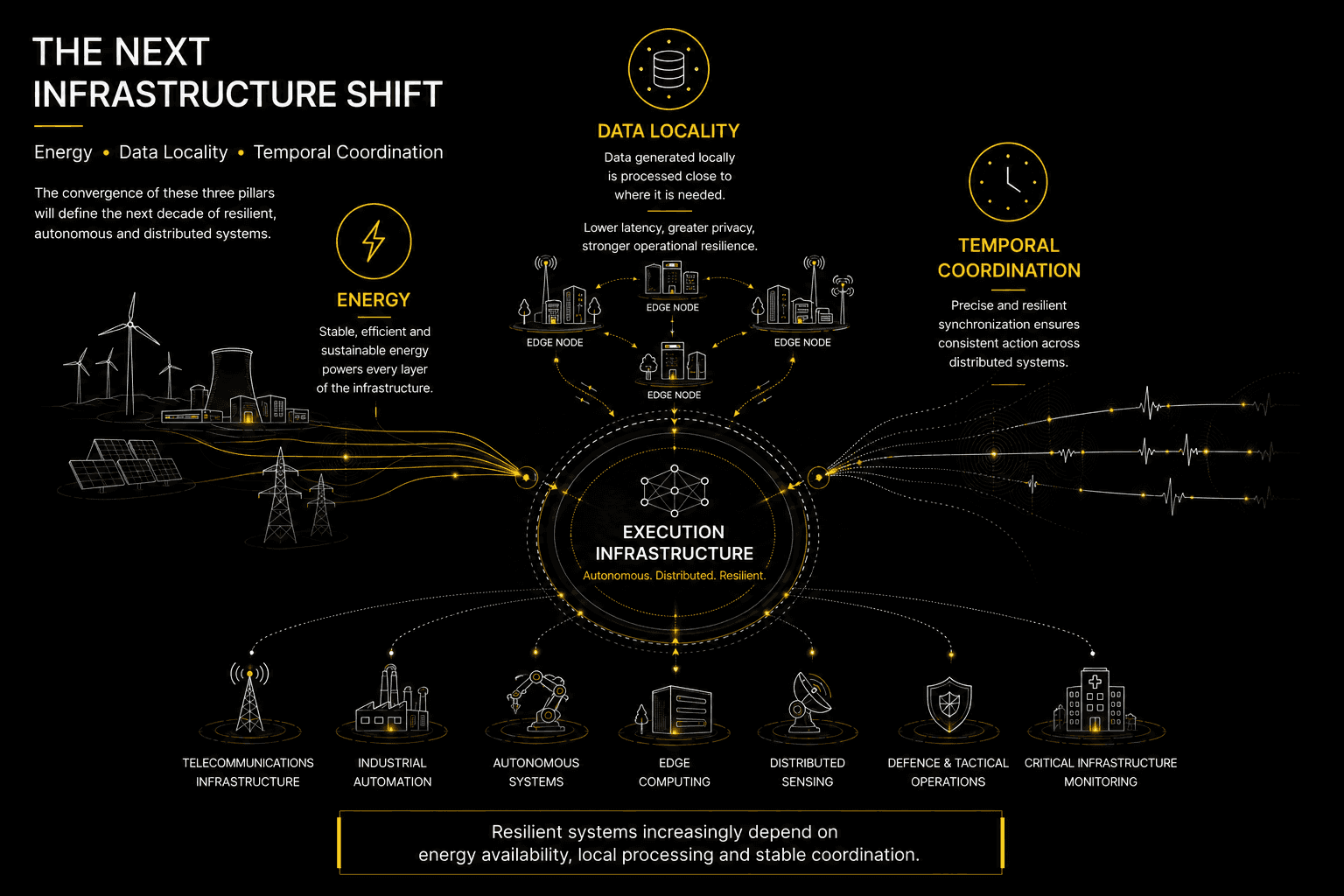
As these constraints converge, three infrastructure layers are becoming strategically interconnected:

Energy availability, data locality and temporal coordination.

The observations below reflect INNOV’s long-term perspective on how distributed infrastructure architectures may evolve over the coming decade.


For more than three decades, modern digital infrastructure evolved around a relatively stable assumption:

  • networks would remain globally connected

  • cloud infrastructure would remain continuously reachable

  • external timing references would remain available

  • software abstraction would compensate for most physical infrastructure limitations

This model enabled the rise of:

  • cloud computing

  • hyperscale datacenters

  • global internet platforms

  • mobile ecosystems

  • large-scale distributed services

Under these conditions, infrastructure was primarily optimized around:

  • compute scaling

  • bandwidth growth

  • software flexibility

  • centralized processing

That environment is now changing.

Artificial intelligence, edge computing, industrial automation, autonomous systems and real-time distributed infrastructures are introducing new physical constraints that software abstraction alone can no longer fully absorb.

Distributed systems are becoming increasingly:

  • latency-sensitive

  • energy-intensive

  • coordination-dependent

  • infrastructure-aware

  • autonomous under degraded conditions

As these constraints converge, three infrastructure layers are becoming strategically interconnected:

Energy availability, data locality and temporal coordination.

The observations below reflect INNOV’s long-term perspective on how distributed infrastructure architectures may evolve over the coming decade.

I. Energy Is Becoming a Core Infrastructure Constraint

Artificial intelligence is often discussed primarily through models, algorithms and compute acceleration.

In practice, modern AI infrastructure increasingly depends on something more fundamental:

stable energy availability.

Training and operating large-scale AI systems requires enormous electrical capacity. High-density compute clusters, accelerated inference platforms and distributed edge infrastructure introduce power and thermal requirements that are becoming structural engineering constraints rather than operational optimizations.

This is already visible across:

  • hyperscale AI datacenters

  • GPU compute clusters

  • edge AI infrastructure

  • industrial AI systems

  • AI datacenter infrastructure

  • autonomous operational platforms

  • distributed robotics

  • defense-oriented compute environments

The question is no longer only:

“How much compute is available?”

Increasingly, the question becomes:

“How much stable energy can be delivered continuously and operationally?”


Energy and Technological Sovereignty

This shift has direct implications for technological sovereignty.

AI capability increasingly depends not only on software leadership, but also on:

  • energy production

  • cooling infrastructure

  • thermal efficiency

  • sovereign AI infrastructure

  • infrastructure resilience

  • local compute deployment

  • electrical grid stability

As AI infrastructure expands globally, interest is accelerating around:

  • modular energy systems

  • resilient datacenter infrastructure

  • distributed compute environments

  • localized inference

  • edge processing

  • advanced cooling systems

  • infrastructure-efficient AI deployment

This is one reason why energy is progressively becoming a strategic infrastructure concern rather than simply an operational cost.


II. Data Is Already a Strategic Infrastructure Resource

Even before the rise of modern AI systems, digital infrastructure already depended heavily on large-scale data generation, processing and analysis.

Modern platforms continuously rely on operational data for:

  • logistics optimization

  • industrial monitoring

  • telecommunications management

  • financial systems

  • recommendation systems

  • predictive maintenance

  • cloud orchestration

  • operational analytics

Over time, data evolved from a simple operational byproduct into a foundational infrastructure resource.

The growth of artificial intelligence accelerates this shift significantly.

Modern AI systems depend on enormous quantities of data for:

  • model training

  • inference optimization

  • operational adaptation

  • predictive systems

  • automation

  • distributed decision environments

As AI infrastructure expands, controlling where data is generated, processed and governed becomes increasingly important.


Why Data Locality Matters

For years, centralized cloud infrastructure offered major scaling advantages.

However, distributed operational systems increasingly face environments where centralized processing introduces limitations:

  • latency

  • bandwidth dependency

  • operational fragility

  • sovereignty concerns

  • intermittent connectivity

  • degraded communication conditions

This becomes particularly important in:

  • industrial automation

  • edge AI

  • distributed sensing

  • autonomous systems

  • operational technology environments

  • tactical communications

  • infrastructure monitoring systems

In these environments, routing all computation through centralized infrastructure is not always operationally optimal.


The Rise of Edge and Local Inference

This is accelerating the transition toward:

  • on-device interference

  • edge computing

  • local inference

  • distributed processing

  • regional infrastructure

  • AI interference infrastructure

  • infrastructure-aware AI deployment

  • resilient compute architectures

The objective is not necessarily to replace cloud infrastructure.

The objective is to reduce dependency on permanent centralized availability for systems that must continue operating under constrained conditions.

As a result, data locality is becoming more than a performance optimization.

It is increasingly becoming a resilience architecture decision.


III. Temporal Coordination Is Emerging as a Foundational Layer

As distributed infrastructures become increasingly autonomous and time-sensitive, coordination itself becomes a major engineering challenge.

Modern systems already rely heavily on synchronization layers for:

  • telecommunications infrastructure

  • industrial automation

  • distributed databases

  • sensor fusion

  • financial timestamping

  • edge orchestration

  • radio access networks

  • operational coordination systems

  • deterministic distributed infrastructure

Under stable operating conditions, existing synchronization architectures perform extremely well.

But most current infrastructures were designed around assumptions that include:

  • stable connectivity

  • bounded latency

  • continuous external timing availability

  • persistent infrastructure access

  • stable synchronization hierarchies

In degraded environments, these assumptions may no longer consistently hold.


The Limits of Best-Effort Coordination

Traditional distributed systems were largely designed around best-effort networking behavior.

That model remains highly effective for many applications.

However, real-time distributed infrastructure increasingly operates closer to physical coordination limits where temporal uncertainty itself becomes operationally important.

This becomes increasingly relevant across:

  • AI inference infrastructure

  • industrial robotics

  • autonomous operational systems

  • telecom fronthaul

  • distributed sensing

  • edge orchestration

  • tactical communication systems

  • real-time distributed platforms

In these environments, even relatively small synchronization inconsistencies may propagate operational effects across distributed infrastructures.

This does not mean current synchronization approaches are obsolete.

It means distributed infrastructures are evolving toward environments where tighter temporal coordination becomes increasingly valuable.


Why Temporal Coordination Matters

More stable synchronization consistency may improve distributed infrastructure behavior in several ways.

Reduced Coordination Uncertainty

Distributed systems frequently compensate for timing uncertainty through:

  • synchronization margins

  • retry windows

  • buffering

  • conservative scheduling behavior

  • operational redundancy

Reducing temporal uncertainty may improve coordination consistency across distributed infrastructures.


Improved Infrastructure Efficiency

Distributed compute systems often spend significant resources compensating for coordination inconsistencies between nodes.

More stable temporal coordination may reduce:

  • idle waiting

  • synchronization overhead

  • unnecessary retransmissions

  • distributed coordination inefficiencies

At hyperscale infrastructure levels, these effects become increasingly significant.


Operational Continuity Under Degraded Conditions

The importance of synchronization increases further when infrastructure assumptions degrade.

In constrained operational environments:

  • communication quality may fluctuate

  • infrastructure may fragment

  • centralized systems may become unavailable

  • GNSS access may degrade

  • distributed systems may continue operating autonomously

Maintaining coordination continuity under these conditions becomes significantly more difficult.

This is one reason resilient synchronization architectures are attracting increasing interest across:

  • telecommunications

  • defense

  • edge computing

  • industrial infrastructure

  • distributed operational systems

  • critical infrastructure resilience research


We Are Moving From an Internet of Consumption to an Infrastructure of Execution.

The previous generation of internet infrastructure primarily supported consumption-oriented workloads:

  • web browsing

  • streaming

  • cloud applications

  • centralized digital services

The next generation increasingly supports execution-oriented systems:

  • autonomous platforms

  • distributed AI

  • distributed AI infrastructure

  • industrial robotics

  • edge decision systems

  • operational infrastructure

  • real-time distributed environments

These systems interact directly with the physical world.

As a result, infrastructure timing consistency, operational continuity and coordination stability become far more important than in traditional consumer internet architectures.


Why Timing Coordination Is Becoming a Cross-Industry Problem

Temporal coordination is no longer limited to telecommunications infrastructure alone.

The same synchronization constraints increasingly appear across:

  • AI infrastructure

  • distributed robotics

  • industrial control systems

  • autonomous mobility platforms

  • edge computing

  • distributed sensing

  • cloud-edge orchestration

  • operational technology environments

As these systems become increasingly distributed and autonomous, maintaining stable coordination under degraded conditions becomes a broader infrastructure challenge rather than a niche telecom problem.


The Growing Importance of Infrastructure Resilience

One of the largest infrastructure shifts currently underway is the transition from:

optimizing for nominal conditions

toward:

designing for degraded operational continuity.

Historically, degraded conditions were treated as temporary exceptions.

Increasingly, infrastructure operators must assume that constrained environments may persist operationally for extended periods.

This changes architectural priorities significantly for infrastructure sovereignty.

Resilience is no longer limited to redundancy alone.

It increasingly involves maintaining operational coordination despite:

  • unstable connectivity

  • infrastructure fragmentation

  • degraded communication conditions

  • timing degradation

  • constrained environments

  • intermittent external dependencies


The Architectural Direction Ahead

Future distributed infrastructures will likely require tighter integration between:

  • compute infrastructure

  • energy management

  • local processing

  • synchronization architectures

  • distributed coordination layers

  • resilient operational systems

  • infrastructure-aware AI systems

This does not imply replacing existing cloud or timing infrastructure.

Rather, it suggests an evolution toward complementary resilience architectures capable of operating under a broader range of real-world conditions.


Relevant infrastructure domains and operational environments associated with these transitions include:

  • AI infrastructure and accelerated compute systems

  • edge computing and local inference architectures

  • distributed AI infrastructure

  • post-cloud infrastructure architectures

  • telecom synchronization systems

  • resilient datacenter infrastructure

  • sovereign AI and infrastructure resilience

  • industrial edge systems

  • operational technology environments

  • autonomous distributed platforms

  • deterministic distributed infrastructure

  • distributed synchronization architectures

  • infrastructure-aware AI deployment


III. Temporal Coordination Is Emerging as a Foundational Layer

As distributed infrastructures become increasingly autonomous and time-sensitive, coordination itself becomes a major engineering challenge.

Modern systems already rely heavily on synchronization layers for:

  • telecommunications infrastructure

  • industrial automation

  • distributed databases

  • sensor fusion

  • financial timestamping

  • edge orchestration

  • radio access networks

  • operational coordination systems

Under stable operating conditions, existing synchronization architectures perform extremely well.

But most current infrastructures were designed around assumptions that include:

  • stable connectivity

  • bounded latency

  • continuous external timing availability

  • persistent infrastructure access

  • stable synchronization hierarchies

In degraded environments, these assumptions may no longer consistently hold.


The Limits of Best-Effort Coordination

Traditional distributed systems were largely designed around best-effort networking behavior.

That model remains highly effective for many applications.

However, real-time distributed infrastructure increasingly operates closer to physical coordination limits where temporal uncertainty itself becomes operationally important.

This becomes increasingly relevant across:

  • AI inference infrastructure

  • industrial robotics

  • autonomous operational systems

  • telecom fronthaul

  • distributed sensing

  • edge orchestration

  • tactical communication systems

  • real-time distributed platforms

In these environments, even relatively small synchronization inconsistencies may propagate operational effects across distributed infrastructures.

This does not mean current synchronization approaches are obsolete.

It means distributed infrastructures are evolving toward environments where tighter temporal coordination becomes increasingly valuable.


Why Temporal Coordination Matters

More stable synchronization consistency may improve distributed infrastructure behavior in several ways.

Reduced Coordination Uncertainty

Distributed systems frequently compensate for timing uncertainty through:

  • synchronization margins

  • retry windows

  • buffering

  • conservative scheduling behavior

  • operational redundancy

Reducing temporal uncertainty may improve coordination consistency across distributed infrastructures.


Improved Infrastructure Efficiency

Distributed compute systems often spend significant resources compensating for coordination inconsistencies between nodes.

More stable temporal coordination may reduce:

  • idle waiting

  • synchronization overhead

  • unnecessary retransmissions

  • distributed coordination inefficiencies

At hyperscale infrastructure levels, these effects become increasingly significant.


Operational Continuity Under Degraded Conditions

The importance of synchronization increases further when infrastructure assumptions degrade.

In constrained operational environments:

  • communication quality may fluctuate

  • infrastructure may fragment

  • centralized systems may become unavailable

  • GNSS access may degrade

  • distributed systems may continue operating autonomously

Maintaining coordination continuity under these conditions becomes significantly more difficult.

This is one reason resilient synchronization architectures are attracting increasing interest across:

  • telecommunications

  • defense

  • edge computing

  • industrial infrastructure

  • distributed operational systems

  • critical infrastructure resilience research


We Are Moving From an Internet of Consumption to an Infrastructure of Execution.

The previous generation of internet infrastructure primarily supported consumption-oriented workloads:

  • web browsing

  • streaming

  • cloud applications

  • centralized digital services

The next generation increasingly supports execution-oriented systems:

  • autonomous platforms

  • distributed AI

  • industrial robotics

  • edge decision systems

  • operational infrastructure

  • real-time distributed environments

These systems interact directly with the physical world.

As a result, infrastructure timing consistency, operational continuity and coordination stability become far more important than in traditional consumer internet architectures.


Why Timing Coordination Is Becoming a Cross-Industry Problem

Temporal coordination is no longer limited to telecommunications infrastructure alone.

The same synchronization constraints increasingly appear across:

  • AI infrastructure

  • distributed robotics

  • industrial control systems

  • autonomous mobility platforms

  • edge computing

  • distributed sensing

  • cloud-edge orchestration

  • operational technology environments

As these systems become increasingly distributed and autonomous, maintaining stable coordination under degraded conditions becomes a broader infrastructure challenge rather than a niche telecom problem.


The Growing Importance of Infrastructure Resilience

One of the largest infrastructure shifts currently underway is the transition from:

optimizing for nominal conditions

toward:

designing for degraded operational continuity.

Historically, degraded conditions were treated as temporary exceptions.

Increasingly, infrastructure operators must assume that constrained environments may persist operationally for extended periods.

This changes architectural priorities significantly.

Resilience is no longer limited to redundancy alone.

It increasingly involves maintaining operational coordination despite:

  • unstable connectivity

  • infrastructure fragmentation

  • degraded communication conditions

  • timing degradation

  • constrained environments

  • intermittent external dependencies


The Architectural Direction Ahead

Future distributed infrastructures will likely require tighter integration between:

  • compute infrastructure

  • energy management

  • local processing

  • synchronization architectures

  • distributed coordination layers

  • resilient operational systems

This does not imply replacing existing cloud or timing infrastructure.

Rather, it suggests an evolution toward complementary resilience architectures capable of operating under a broader range of real-world conditions.

Relevant infrastructure domains and operational environments associated with these transitions include:

  • AI infrastructure and accelerated compute systems

  • edge computing and local inference architectures

  • distributed AI infrastructure

  • post-cloud infrastructure architectures

  • telecom synchronization systems

  • resilient datacenter infrastructure

  • sovereign AI and infrastructure resilience

  • industrial edge systems

  • operational technology environments

  • autonomous distributed platforms

  • deterministic distributed infrastructure

  • distributed synchronization architectures

  • infrastructure-aware AI deployment

INNOV’s Perspective

INNOV’s ongoing work around distributed synchronization and resilient coordination architectures is based on a broader observation:

as distributed systems become increasingly autonomous, real-time and infrastructure-sensitive, temporal coordination itself becomes a strategic infrastructure layer.

The objective is not to replace existing synchronization ecosystems.

The objective is to explore complementary architectures capable of maintaining distributed coordination continuity under conditions where traditional assumptions become unreliable.

Experimental validation work currently continues across constrained embedded distributed environments operating without centralized infrastructure dependency.

Certain architectural and operational mechanisms remain intentionally undisclosed publicly.

For additional technical context:


INNOV’s ongoing work around distributed synchronization and resilient coordination architectures is based on a broader observation:

as distributed systems become increasingly autonomous, real-time and infrastructure-sensitive, temporal coordination itself becomes a strategic infrastructure layer.

The objective is not to replace existing synchronization ecosystems.

The objective is to explore complementary architectures capable of maintaining distributed coordination continuity under conditions where traditional assumptions become unreliable.

Experimental validation work currently continues across constrained embedded distributed environments operating without centralized infrastructure dependency.

Certain architectural and operational mechanisms remain intentionally undisclosed publicly.

For additional technical context:


Current Status

Experimental validation is currently ongoing across real embedded distributed environments operating under constrained conditions.

Initial intellectual property filings related to distributed synchronization, temporal coherence and resilient infrastructure architectures were initiated in 2026.

INNOV is currently open to technical discussions, collaborative validation opportunities and operational exchanges with industrial and research partners working on distributed systems, synchronization infrastructure and resilient operational architectures.


Experimental validation is currently ongoing across real embedded distributed environments operating under constrained conditions.

Initial intellectual property filings related to distributed synchronization, temporal coherence and resilient infrastructure architectures were initiated in 2026.

INNOV is currently open to technical discussions, collaborative validation opportunities and operational exchanges with industrial and research partners working on distributed systems, synchronization infrastructure and resilient operational architectures.

Open to exchange?

We are happy to discuss our technology and fields of use with you. Schedule a call directly or get in touch with us.

Open to exchange?

We are happy to discuss our technology and fields of use with you. Schedule a call directly or get in touch with us.

Copyright © 2026 INNOV Société. All rights reserved.

Copyright © 2026 INNOV Société.

All rights reserved.