Why Synchronization Became a Structural Infrastructure Problem

How modern digital infrastructure evolved from latency-tolerant networks into real-time distributed execution systems — while most synchronization assumptions remained largely unchanged.

Modern digital infrastructure was not originally designed for the operational realities emerging today.

The early internet was built primarily for:

  • communication

  • document exchange

  • asynchronous information access

  • centralized computing environments

Latency existed, but most applications tolerated it.

Timing consistency mattered, but only within relatively narrow operational domains such as telecommunications backbones, military systems or specialized industrial infrastructure.

Most digital services did not require strict distributed temporal coordination to function correctly.

That environment progressively changed.

Over the last thirty years, distributed systems evolved continuously:

  • internet traffic exploded

  • streaming platforms emerged

  • cloud computing centralized infrastructure globally

  • mobile devices created always-connected ecosystems

  • edge computing distributed processing geographically

  • artificial intelligence accelerated compute density and automation

  • autonomous systems introduced real-time operational decision loops

The infrastructure layers built on top of digital networks evolved rapidly.

The synchronization assumptions beneath them evolved much more slowly.

This progressively created a structural gap between:

the operational behavior modern systems require and the timing architectures many infrastructures still fundamentally depend on.

Synchronization Was Often Treated as an Invisible Utility

For decades, synchronization remained mostly invisible to the public internet ecosystem.

As long as:

  • systems remained relatively centralized

  • networks stayed reasonably stable

  • applications tolerated latency variation

  • workloads were not strongly real-time

  • distributed coordination demands remained moderate

existing synchronization approaches were generally sufficient.

In most environments, synchronization became something treated as:

  • background infrastructure

  • hidden operational plumbing

  • an abstract service layer

  • a dependency managed indirectly through existing protocols

This made sense historically.

The early internet was not designed as an infrastructure of autonomous distributed execution.

It was primarily designed as an infrastructure of communication and information exchange.

The architectural assumptions of that era shaped many of the timing approaches still widely deployed today.
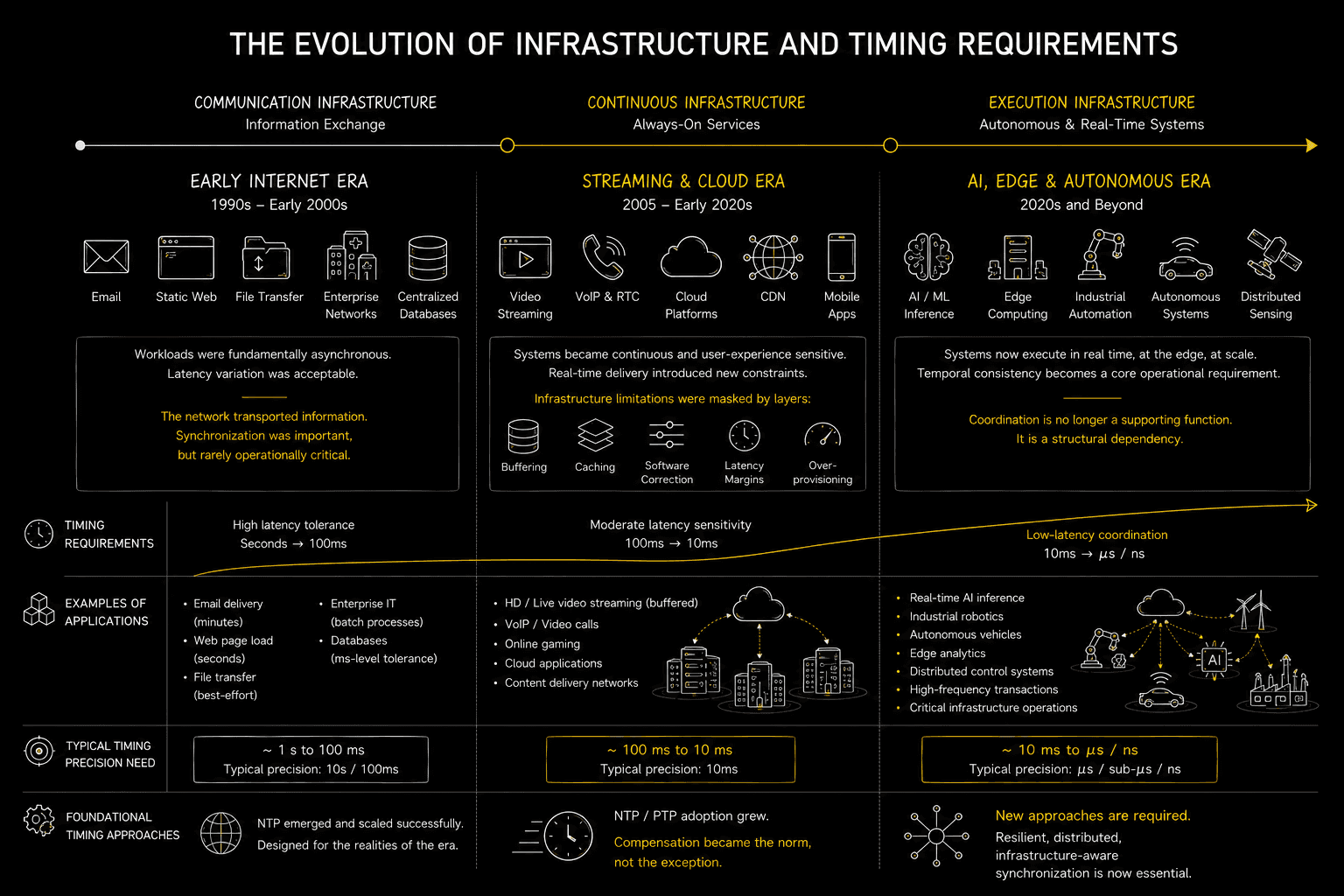
The Early Internet Era

The first generations of internet infrastructure operated in environments where timing precision was important but rarely operationally critical for mainstream systems.

Typical internet applications included:

  • email

  • static web pages

  • file transfer

  • enterprise networking

  • centralized database systems

Most workloads were fundamentally asynchronous.

A request arriving:

  • 20 milliseconds later

  • 100 milliseconds later

  • or even several seconds later

usually remained operationally acceptable.

The network primarily transported information.

It was not yet coordinating large-scale distributed real-time execution systems.

Protocols such as NTP emerged in this environment and were highly effective for the operational realities of the time.

They provided:

  • scalable synchronization

  • low deployment complexity

  • broad interoperability

  • sufficient timing consistency for most enterprise environments

For the internet era they were designed for, these systems performed extremely well.


Streaming and the Rise of Continuous Infrastructure

The evolution toward streaming platforms introduced a major architectural transition.

The internet progressively shifted from:

  • static asynchronous exchange

toward:

  • continuous synchronized media distribution.

Video streaming, VoIP and real-time communication systems introduced new constraints:

  • buffering management

  • packet sequencing

  • media synchronization

  • latency sensitivity

  • continuous throughput stability

Synchronization became increasingly important operationally.

But most systems still compensated through:

  • buffering

  • caching

  • software correction layers

  • latency margins

  • overprovisioning

In practice, many infrastructure limitations were masked rather than fundamentally solved.

The underlying timing assumptions remained relatively unchanged.


Cloud Computing Centralized Infrastructure at Massive Scale

Cloud infrastructure introduced another major transformation.

Distributed systems became globally interconnected through hyperscale infrastructure environments operated by a small number of centralized platforms.

This enabled extraordinary scalability across:

  • storage

  • compute

  • orchestration

  • distributed applications

  • infrastructure automation

At the same time, cloud computing reinforced a key architectural assumption:

centralized infrastructure availability could largely be treated as permanent.

For many operational environments, this assumption was economically and technically efficient.

But it also reduced the perceived urgency of developing synchronization architectures optimized for:

  • disconnected operation

  • degraded environments

  • infrastructure fragmentation

  • autonomous distributed coordination

Most systems continued operating under the assumption that authoritative timing references and centralized infrastructure layers would remain continuously reachable.

The Early Internet Era

The first generations of internet infrastructure operated in environments where timing precision was important but rarely operationally critical for mainstream systems.

Typical internet applications included:

  • email

  • static web pages

  • file transfer

  • enterprise networking

  • centralized database systems

Most workloads were fundamentally asynchronous.

A request arriving:

  • 20 milliseconds later

  • 100 milliseconds later

  • or even several seconds later

usually remained operationally acceptable.

The network primarily transported information.

It was not yet coordinating large-scale distributed real-time execution systems.

Protocols such as NTP emerged in this environment and were highly effective for the operational realities of the time.

They provided:

  • scalable synchronization

  • low deployment complexity

  • broad interoperability

  • sufficient timing consistency for most enterprise environments

For the internet era they were designed for, these systems performed extremely well.


Streaming and the Rise of Continuous Infrastructure

The evolution toward streaming platforms introduced a major architectural transition.

The internet progressively shifted from:

  • static asynchronous exchange

toward:

  • continuous synchronized media distribution.

Video streaming, VoIP and real-time communication systems introduced new constraints:

  • buffering management

  • packet sequencing

  • media synchronization

  • latency sensitivity

  • continuous throughput stability

Synchronization became increasingly important operationally.

But most systems still compensated through:

  • buffering

  • caching

  • software correction layers

  • latency margins

  • overprovisioning

In practice, many infrastructure limitations were masked rather than fundamentally solved.

The underlying timing assumptions remained relatively unchanged.


Cloud Computing Centralized Infrastructure at Massive Scale

Cloud infrastructure introduced another major transformation.

Distributed systems became globally interconnected through hyperscale infrastructure environments operated by a small number of centralized platforms.

This enabled extraordinary scalability across:

  • storage

  • compute

  • orchestration

  • distributed applications

  • infrastructure automation

At the same time, cloud computing reinforced a key architectural assumption:

centralized infrastructure availability could largely be treated as permanent.

For many operational environments, this assumption was economically and technically efficient.

But it also reduced the perceived urgency of developing synchronization architectures optimized for:

  • disconnected operation

  • degraded environments

  • infrastructure fragmentation

  • autonomous distributed coordination

Most systems continued operating under the assumption that authoritative timing references and centralized infrastructure layers would remain continuously reachable.

Mobile Infrastructure and Always-On Coordination

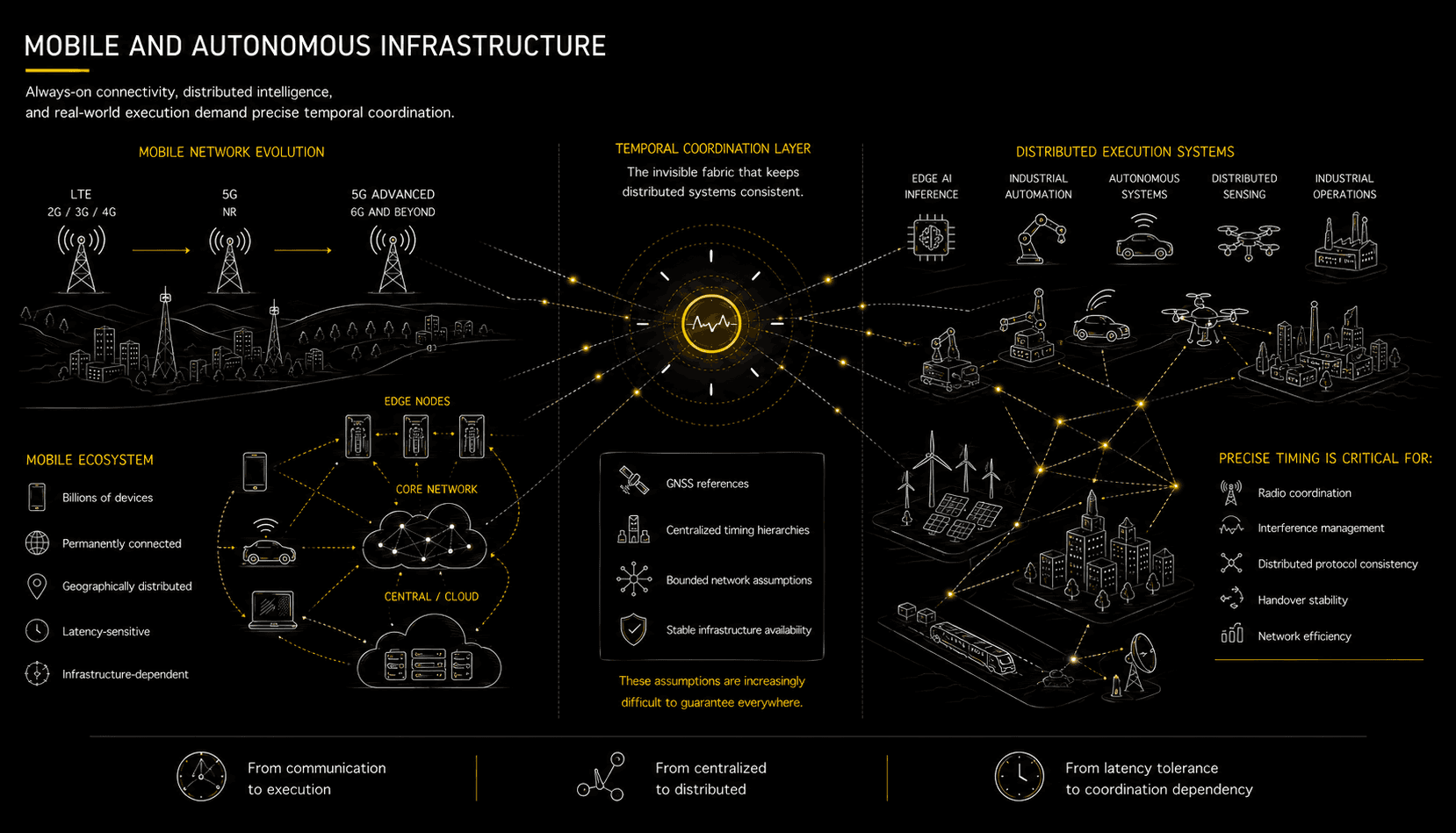
The rise of smartphones and mobile ecosystems accelerated distributed infrastructure complexity significantly.

Billions of devices became:

  • permanently connected

  • geographically distributed

  • latency-sensitive

  • infrastructure-dependent

Telecommunications synchronization requirements expanded dramatically with:

  • LTE

  • 4G

  • 5G radio coordination

  • carrier aggregation

  • distributed radio access networks

  • fronthaul synchronization

  • mobile edge infrastructure

Precise timing increasingly became operationally critical for maintaining:

  • radio coordination

  • interference management

  • distributed protocol consistency

  • handover stability

  • network efficiency

Yet even in these infrastructures, synchronization often remained dependent on:

  • GNSS references

  • centralized timing hierarchies

  • bounded network assumptions

  • stable infrastructure availability

The systems became more advanced.

The foundational timing assumptions often remained similar.

AI and Autonomous Systems Changed the Nature of Infrastructure

Artificial intelligence, edge computing and autonomous operational systems introduced a deeper infrastructure transition.

Modern infrastructures increasingly do not simply distribute information.

They distribute execution.

This is a major difference.

Distributed infrastructures increasingly coordinate:

  • autonomous decision systems

  • industrial robotics

  • edge inference

  • distributed sensing

  • distributed infrastructure orchestration

  • operational technology

  • tactical systems

  • real-time orchestration

  • real-time distributed systems

  • machine-to-machine interaction

These systems interact directly with physical environments.

As a result:
timing inconsistency increasingly becomes operational inconsistency.

This is fundamentally different from traditional web infrastructure environments.

We Are Moving From Consumption Infrastructure to Execution Infrastructure

For most of the internet era, digital infrastrucutre primarily supported:

  • media consumption

  • communication

  • centralized services

  • cloud-hosted applications

The next generation of infrastructure increasingly supports:

  • autonomous systems

  • edge execution

  • distributed AI

  • industrial coordination

  • machine automation

  • infrastructure-aware computing

This transition changes the importance of synchronization significantly.

Execution infrastructure depends increasingly on:

  • coordination consistency

  • deterministic behavior

  • bounded latency

  • distributed temporal coherence

  • operational continuity under degraded conditions

The closer systems move toward real-time distributed execution, the harder timing uncertainty becomes to ignore.


The Architectural Debt Beneath Modern Infrastructure

Modern digital infrastructure evolved extraordinarily quickly over the last three decades.

But many synchronization assumptions remained inherited from earlier infrastructure eras where:

  • centralized systems dominated

  • degraded environments were secondary concerns

  • latency tolerance remained higher

  • autonomous distributed execution barely existed

This progressively created a form of architectural debt.

Not because previous architectures were incorrect.

But because modern distributed systems now operate under conditions very different from the environments those synchronization assumptions were originally optimized for.

This becomes increasingly visible in:

  • edge computing

  • industrial automation

  • telecom resilience

  • distributed sensing

  • tactical communication systems

  • autonomous operational environments

  • AI infrastructure coordination

  • degraded infrastructure scenarios

  • temporal consistency across distributed systems

The challenge is no longer simply achieving synchronization accuracy under stable conditions.

The challenge increasingly becomes maintaining coordination continuity when infrastructure assumptions themselves become unreliable.


We Are Moving From Consumption Infrastructure to Execution Infrastructure

For most of the internet era, digital infrastrucutre primarily supported:

  • media consumption

  • communication

  • centralized services

  • cloud-hosted applications

The next generation of infrastructure increasingly supports:

  • autonomous systems

  • edge execution

  • distributed AI

  • industrial coordination

  • machine automation

  • infrastructure-aware computing

This transition changes the importance of synchronization significantly.

Execution infrastructure depends increasingly on:

  • coordination consistency

  • deterministic behavior

  • bounded latency

  • distributed temporal coherence

  • operational continuity under degraded conditions

The closer systems move toward real-time distributed execution, the harder timing uncertainty becomes to ignore.


The Architectural Debt Beneath Modern Infrastructure

Modern digital infrastructure evolved extraordinarily quickly over the last three decades.

But many synchronization assumptions remained inherited from earlier infrastructure eras where:

  • centralized systems dominated

  • degraded environments were secondary concerns

  • latency tolerance remained higher

  • autonomous distributed execution barely existed

This progressively created a form of architectural debt.

Not because previous architectures were incorrect.

But because modern distributed systems now operate under conditions very different from the environments those synchronization assumptions were originally optimized for.

This becomes increasingly visible in:

  • edge computing

  • industrial automation

  • telecom resilience

  • distributed sensing

  • tactical communication systems

  • autonomous operational environments

  • AI infrastructure coordination

  • degraded infrastructure scenarios

The challenge is no longer simply achieving synchronization accuracy under stable conditions.

The challenge increasingly becomes maintaining coordination continuity when infrastructure assumptions themselves become unreliable.

Why This Matters Now

Several infrastructure trends are converging simultaneously:

  • AI increases distributed compute intensity

  • edge computing distributes processing geographically

  • autonomous systems require continuous coordination

  • critical infrastructures become increasingly software-defined

  • operational systems become increasingly latency-sensitive

  • degraded infrastructure conditions become more operationally relevant

These trends collectively increase the importance of resilient synchronization architectures.

This does not mean existing synchronization systems suddenly became obsolete.

Current infrastructures remain extremely effective across many operational environments.

But the requirements emerging around:

  • resilience

  • distributed autonomy

  • degraded operation

  • infrastructure independence

  • temporal consistency

are increasingly exposing the limits of assumptions inherited from previous infrastructure eras.


Several infrastructure trends are converging simultaneously:

  • AI increases distributed compute intensity

  • edge computing distributes processing geographically

  • autonomous systems require continuous coordination

  • critical infrastructures become increasingly software-defined

  • operational systems become increasingly latency-sensitive

  • degraded infrastructure conditions become more operationally relevant

These trends collectively increase the importance of resilient synchronization architectures.

This does not mean existing synchronization systems suddenly became obsolete.

Current infrastructures remain extremely effective across many operational environments.

But the requirements emerging around:

  • resilience

  • distributed autonomy

  • degraded operation

  • infrastructure independence

  • temporal consistency

are increasingly exposing the limits of assumptions inherited from previous infrastructure eras.

Synchronization Is No Longer Just a Telecom Problem

Historically, precise synchronization was often associated primarily with:

  • telecommunications

  • scientific instrumentation

  • military systems

  • specialized industrial infrastructure

Today, timing coordination increasingly affects:

  • AI infrastructure

  • cloud-edge orchestration

  • industrial automation

  • autonomous mobility

  • distributed robotics

  • edge inference

  • critical infrastructure monitoring

  • distributed operational systems

Synchronization is progressively becoming a broader infrastructure coordination challenge.

Not simply a niche technical discipline.

The Growing Importance of Temporal Resilience

Most distributed infrastructures today still assume eventual recovery of:

  • connectivity

  • centralized infrastructure

  • authoritative timing references

  • stable communication conditions

But future operational environments increasingly require systems capable of maintaining coordination continuity even when degraded conditions persist operationally.

This is one reason resilience architectures are attracting increasing attention across:

  • telecommunications

  • defense

  • industrial infrastructure

  • edge computing

  • distributed AI

  • critical infrastructure resilience

  • autonomous operational systems

The problem is no longer only synchronization accuracy.

Increasingly, the problem becomes: maintaining distributed operational coherence under real-world constrained conditions.

Relevant Infrastructure Domains

Relevant infrastructure domains and operational environments associated with synchronization resilience include:

  • distributed systems infrastructure

  • clock synchronization in distributed networks

  • time-aware distributed architectures

  • edge computing and edge AI infrastructure

  • real-time distributed systems

  • distributed execution infrastructure

  • cloud-edge orchestration

  • telecom synchronization architectures

  • infrastructure-aware computing systems

  • industrial automation infrastructure

  • autonomous distributed systems

  • post-cloud distributed infrastructure

  • distributed temporal coordination

  • resilient synchronization architectures

INNOV’s Perspective

INNOV’s work around distributed synchronization architectures originates from a broader observation:

modern distributed infrastructures evolved far beyond the operational assumptions many synchronization layers were initially designed around.

As distributed systems become increasingly:

  • autonomous

  • infrastructure-sensitive

  • latency-constrained

  • geographically distributed

  • operationally continuous

  • edge AI infrastructure

Temporal coordination itself becomes increasingly strategic.

The objective is not to replace existing infrastructure ecosystems.

The objective is to explore complementary resilience architectures capable of preserving distributed coordination continuity under degraded conditions where traditional assumptions may no longer consistently hold.

Certain synchronization, resilience and operational mechanisms remain intentionally undisclosed publicly.


INNOV’s work around distributed synchronization architectures originates from a broader observation:

modern distributed infrastructures evolved far beyond the operational assumptions many synchronization layers were initially designed around.

As distributed systems become increasingly:

  • autonomous

  • infrastructure-sensitive

  • latency-constrained

  • geographically distributed

  • operationally continuous

  • edge AI infrastructure

Temporal coordination itself becomes increasingly strategic.

The objective is not to replace existing infrastructure ecosystems.

The objective is to explore complementary resilience architectures capable of preserving distributed coordination continuity under degraded conditions where traditional assumptions may no longer consistently hold.

Certain synchronization, resilience and operational mechanisms remain intentionally undisclosed publicly.

Conclusion

Synchronization was never unimportant.

But for decades, most digital infrastructures could continue operating effectively while treating timing coordination largely as an invisible utility layer.

That environment is changing.

As infrastructures evolve from:

  • communication systems
    toward:

  • distributed execution systems

the importance of temporal coordination increases structurally.

Energy availability, data locality and resilient synchronization are progressively converging into a broader infrastructure resilience problem.

The next decade of distributed infrastructure may not be defined only by compute scale or software abstraction.

It may increasingly be defined by how effectively systems maintain operational coordination under real-world conditions where infrastructure assumptions themselves become uncertain.

The transition from communication networks to execution infrastructures requires new approaches to temporal resilience and distributed coordination continuity.

At INNOV, our engineering work focuses specifically on exploring architectures designed for these emerging infrastructure conditions.

Current Status

Experimental validation is currently ongoing across real embedded distributed environments operating under constrained conditions.

Initial intellectual property filings related to distributed synchronization, temporal coherence and resilient infrastructure architectures were initiated in 2026.

INNOV is currently open to technical discussions, collaborative validation opportunities and operational exchanges with industrial and research partners working on distributed systems, synchronization infrastructure and resilient operational architectures.


Experimental validation is currently ongoing across real embedded distributed environments operating under constrained conditions.

Initial intellectual property filings related to distributed synchronization, temporal coherence and resilient infrastructure architectures were initiated in 2026.

INNOV is currently open to technical discussions, collaborative validation opportunities and operational exchanges with industrial and research partners working on distributed systems, synchronization infrastructure and resilient operational architectures.

Open to exchange?

We are happy to discuss our technology and fields of use with you. Schedule a call directly or get in touch with us.

Open to exchange?

We are happy to discuss our technology and fields of use with you. Schedule a call directly or get in touch with us.

Copyright © 2026 INNOV Société. All rights reserved.

Copyright © 2026 INNOV Société.

All rights reserved.