Prototype Results
Experimental validation of distributed synchronization under constrained conditions.
After more than 110 hours of continuous multi-hop operation, stable synchronization behavior was maintained with average synchronization jitter decreased from ~2.0 ms at startup to ~1.5 ms after more than 110 hours of continuous operation, with no observable cumulative drift amplification observed across synchronized nodes and no cumulative drift amplification detected between relays.
Experimental architecture
Below are selected measurements illustrating the evolution of synchronization performance over more than 110 hours of continuous operation.
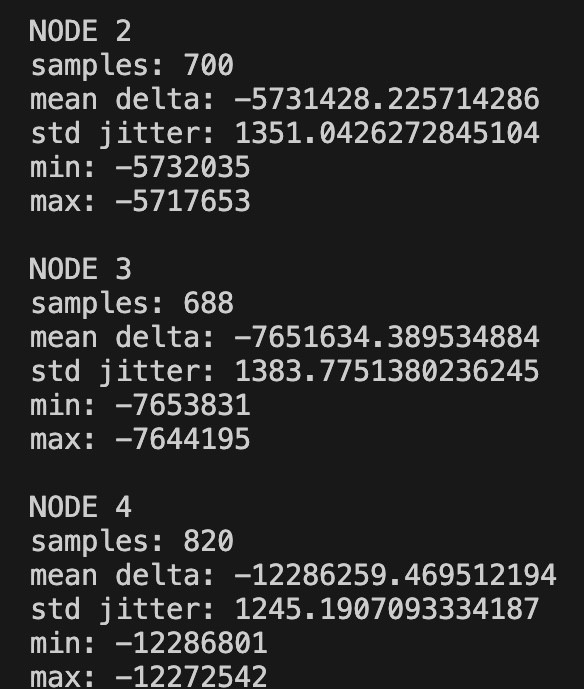
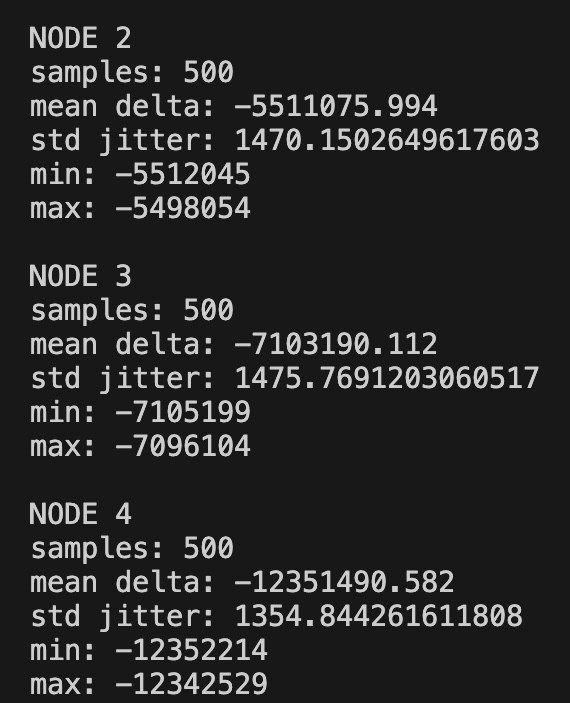
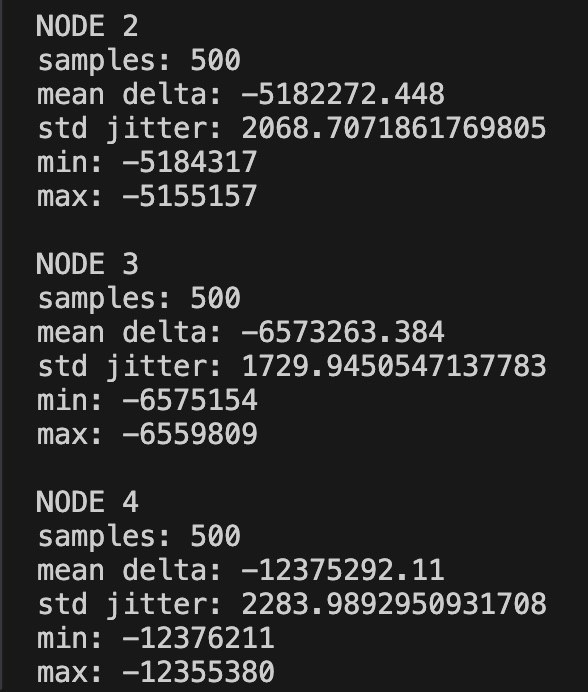
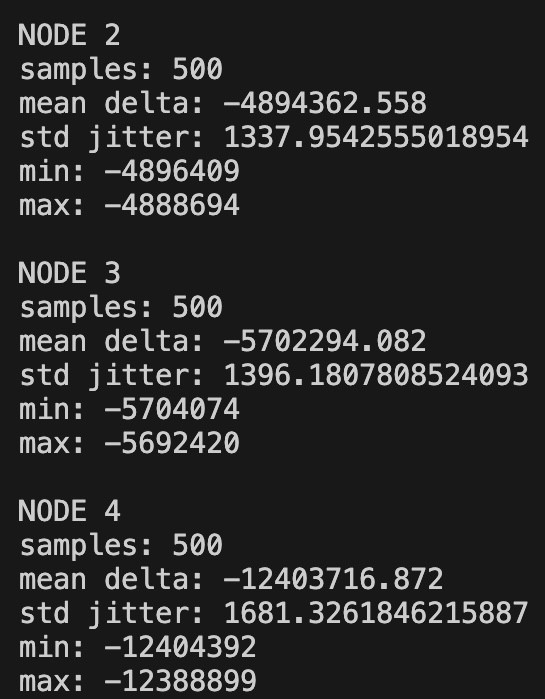
Performance measurements collected from H0 to H110+ under continuous distributed operation.
(H0, H24, H48, H110+)
More than 110 hours of continuous operation without GNSS on low-cost ESP32 hardware, with no observable cumulative drift amplification.
Collaborative Validation Approach
The experimental results described above inform the current validation approach.
INNOV currently prioritizes progressive sector-specific validation environments in order to evaluate synchronization continuity behaviors under real operational constraints.
Current discussions and exploratory validation efforts focus selectively on a limited number of infrastructure environments including telecommunications, autonomous systems, industrial distributed infrastructure, tactical operational systems and resilient edge architectures.
The objective is to maintain focused co-development and operational validation quality rather than scaling experimental deployments prematurely.
Additional collaborative research and validation discussions are evaluated selectively depending on infrastructure relevance and operational alignment.
The experimental observations presented above are further detailed in the full proof-of-concept validation analysis below.