Validated Results

Experimental validation of distributed synchronization under constrained conditions without GNSS, without centralized infrastructure.

Why Distributed Synchronization Becomes Difficult Under Real Conditions

Modern infrastructures rely on systems constantly exchanging time-sensitive information.

Telecommunications networks coordinate radio access between antennas. Distributed sensors need to timestamp events correctly. Autonomous systems depend on synchronized communication between nodes. Financial systems sequence transactions based on precise timing. Cloud and edge architectures rely on consistent temporal coordination between distributed services.

In all of these environments, synchronization is not a secondary optimization layer. It is part of the operational foundation of the system itself.

Most current synchronization architectures depend on one of two models:

  • external timing references such as GNSS (GPS, Galileo, GLONASS, BeiDou)

  • centralized timing distribution systems such as NTP or PTP hierarchies

Under stable conditions, these systems work well.

The problem appears when the environment itself becomes unstable.

GNSS signals can become unavailable, degraded or unreliable. Centralized timing infrastructures introduce dependencies on network availability, IP connectivity and centralized infrastructure components. In degraded environments, distributed systems progressively lose temporal coherence — and once timing coordination begins to drift, operational stability becomes harder to maintain.

In practice, this can affect:

  • radio coordination between telecom sites

  • deterministic communication protocols

  • timestamp integrity

  • distributed sensing consistency

  • edge computing coordination

  • operational continuity during infrastructure degradation

This is the problem INNOV Sync explores experimentally.

The experiments specifically explore:

  • GNSS-free synchronization

  • GPS-denied distributed timing

  • multi-hop clock synchronization without PTP

  • infrastructure-independent temporal coordination

  • distributed embedded synchronization continuity

  • synchronization resilience under degraded communication conditions


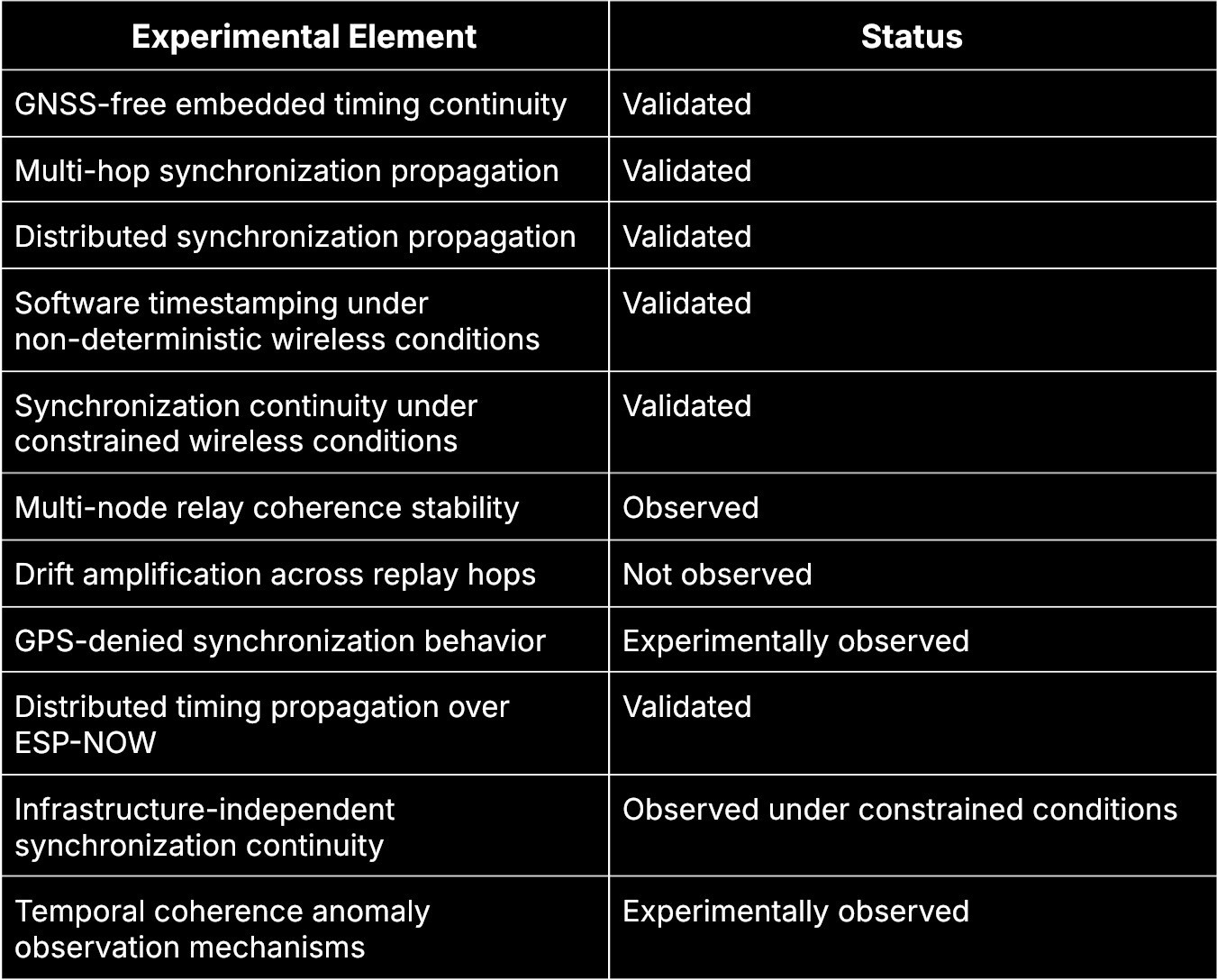
Validated Elements

Validated Elements

Observed synchronization behaviors under constrained distributed conditions
The INNOV Sync Approach

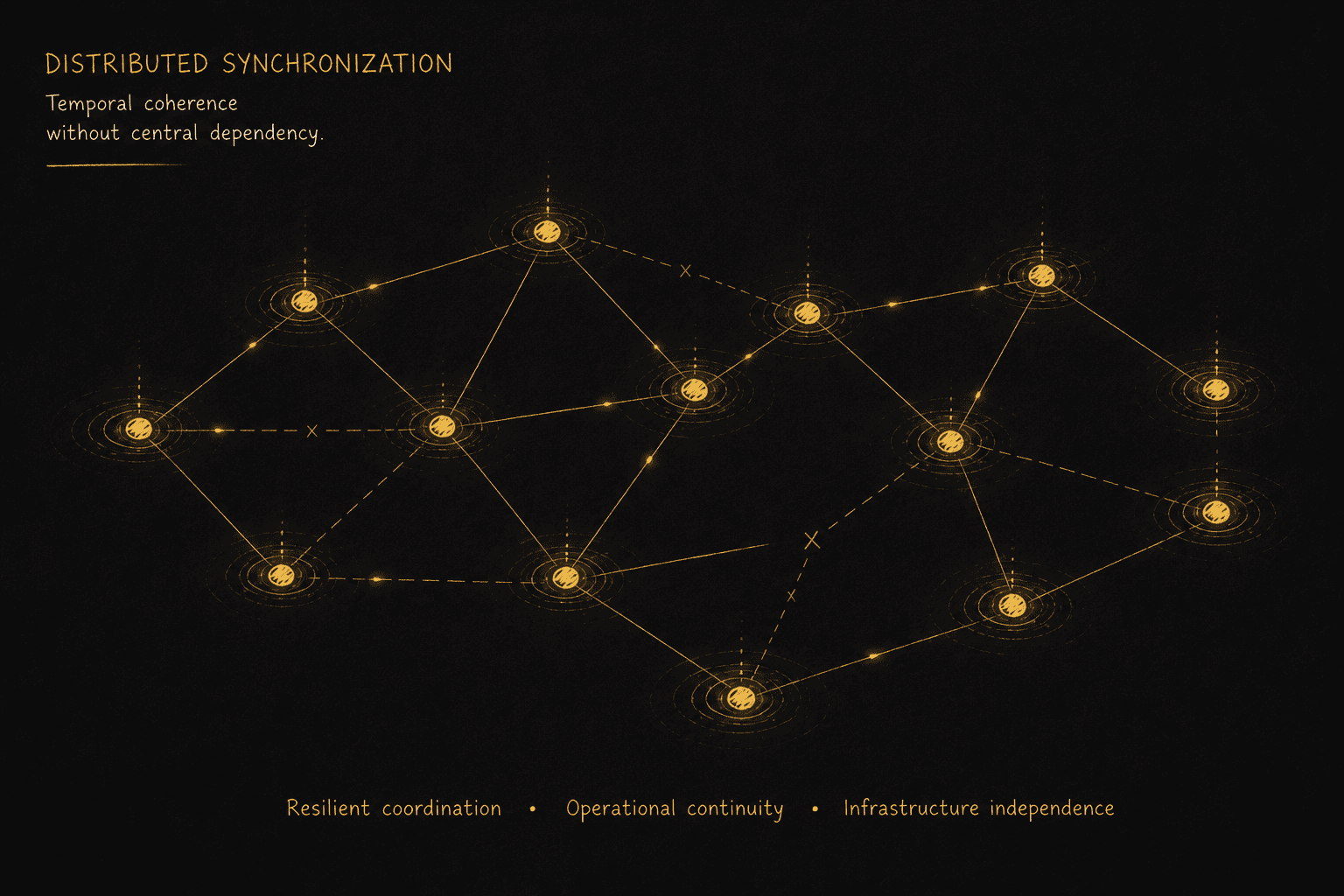
INNOV Sync explores distributed synchronization architectures designed to preserve temporal coherence without permanent dependency on centralized infrastructure or continuous external timing references.

Rather than relying exclusively on a single authoritative timing source, the experimental systems study how distributed infrastructures may maintain stable synchronization behavior across autonomous multi-node environments operating under constrained conditions.

The objective is not to replace existing synchronization infrastructures.

GNSS, NTP and PTP remain highly efficient under many operational scenarios.

The objective is instead to explore complementary resilience architectures capable of maintaining distributed coordination when traditional infrastructure assumptions become unreliable.

This becomes particularly relevant in environments such as:

  • degraded communication environments

  • infrastructure outages

  • GNSS-denied conditions

  • distributed embedded systems

  • autonomous multi-node infrastructures

  • constrained operational deployments

The synchronization mechanisms explored within INNOV Sync are currently protected through intellectual property filings initiated in early 2026 covering distributed synchronization, temporal coherence and resilient infrastructure architectures.
Why We Chose Constrained Hardware

One of the easiest ways to demonstrate synchronization performance is to use expensive deterministic hardware under ideal laboratory conditions.

That was not the objective.

INNOV intentionally chose constrained and imperfect environments from the beginning.

The reason is simple:
real operational systems are rarely ideal.

Wireless communication introduces unpredictable latency. Embedded hardware drifts thermally. Oscillators are unstable. Networks become congested. Infrastructure disappears temporarily. Communication quality changes continuously.

If a synchronization architecture only works under perfect conditions, its operational resilience remains difficult to evaluate.

The experimental prototypes were therefore designed around difficult conditions intentionally:
non-deterministic communication, unstable oscillators, software timestamping and multi-hop propagation across distributed embedded nodes.

The goal was not to maximize performance numbers. The goal was to observe structural synchronization behavior under realistic constraints.

Experimental Architecture

The first validation platform was built using deliberately constrained components and communication layers.

Hardware Environment

The prototypes relied on ESP32 microcontrollers:
low-cost embedded systems with no hardware timestamping support and oscillators subject to thermal and frequency drift.

No specialized synchronization hardware was used.

Communication Layer

Synchronization propagation relied on ESP-NOW:
a lightweight wireless communication protocol operating without centralized IP infrastructure.

Unlike deterministic industrial communication layers, ESP-NOW introduces variable and unpredictable transmission latency depending on radio conditions and local environment behavior.

Timestamping

All temporal measurements were performed at software level only.

No hardware timestamping support was available anywhere in the experimental platform.

This is important because software timestamping itself introduces additional measurement noise and jitter into the system.

Distributed Topology

The architecture relied on distributed multi-node synchronization behaviors operating across several autonomous nodes under non-deterministic conditions

Infrastructure Independence

The experimental environment operated without:

  • GNSS

  • centralized synchronization servers

  • PTP grandmasters

  • NTP infrastructure

  • centralized IP timing architecture

The full synchronization behavior was maintained independently of external timing infrastructure during all validation phases.


The first validation platform was built using deliberately constrained components and communication layers.

Hardware Environment

The prototypes relied on ESP32 microcontrollers:
low-cost embedded systems with no hardware timestamping support and oscillators subject to thermal and frequency drift.

No specialized synchronization hardware was used.

Communication Layer

Synchronization propagation relied on ESP-NOW:
a lightweight wireless communication protocol operating without centralized IP infrastructure.

Unlike deterministic industrial communication layers, ESP-NOW introduces variable and unpredictable transmission latency depending on radio conditions and local environment behavior.

Timestamping

All temporal measurements were performed at software level only.

No hardware timestamping support was available anywhere in the experimental platform.

This is important because software timestamping itself introduces additional measurement noise and jitter into the system.

Distributed Topology

The architecture relied on distributed multi-node synchronization behaviors operating across several autonomous nodes under non-deterministic conditions

Infrastructure Independence

The experimental environment operated without:

  • GNSS

  • centralized synchronization servers

  • PTP grandmasters

  • NTP infrastructure

  • centralized IP timing architecture

The full synchronization behavior was maintained independently of external timing infrastructure during all validation phases.

Experimental Results

The first objective was straightforward:
determine whether stable synchronization behavior could survive under heavily constrained operational conditions.

After more than two hours of continuous multi-hop operation, synchronization remained stable across all distributed nodes in the architecture.

Several observations became particularly important.


The first objective was straightforward:
determine whether stable synchronization behavior could survive under heavily constrained operational conditions.

After more than two hours of continuous multi-hop operation, synchronization remained stable across all distributed nodes in the architecture.

Several observations became particularly important.


Stable Multi-Hop Synchronization

One of the primary concerns in relay-based synchronization systems is cumulative drift amplification.

In many naive relay architectures, timing errors compound progressively at each propagation hop. A node synchronized through multiple relays inherits upstream inaccuracies which then continue accumulating through the network.

During the experiments, this compounding behavior was not observed.

Despite multi-hop propagation across constrained wireless embedded nodes, synchronization remained structurally stable throughout the observation period.
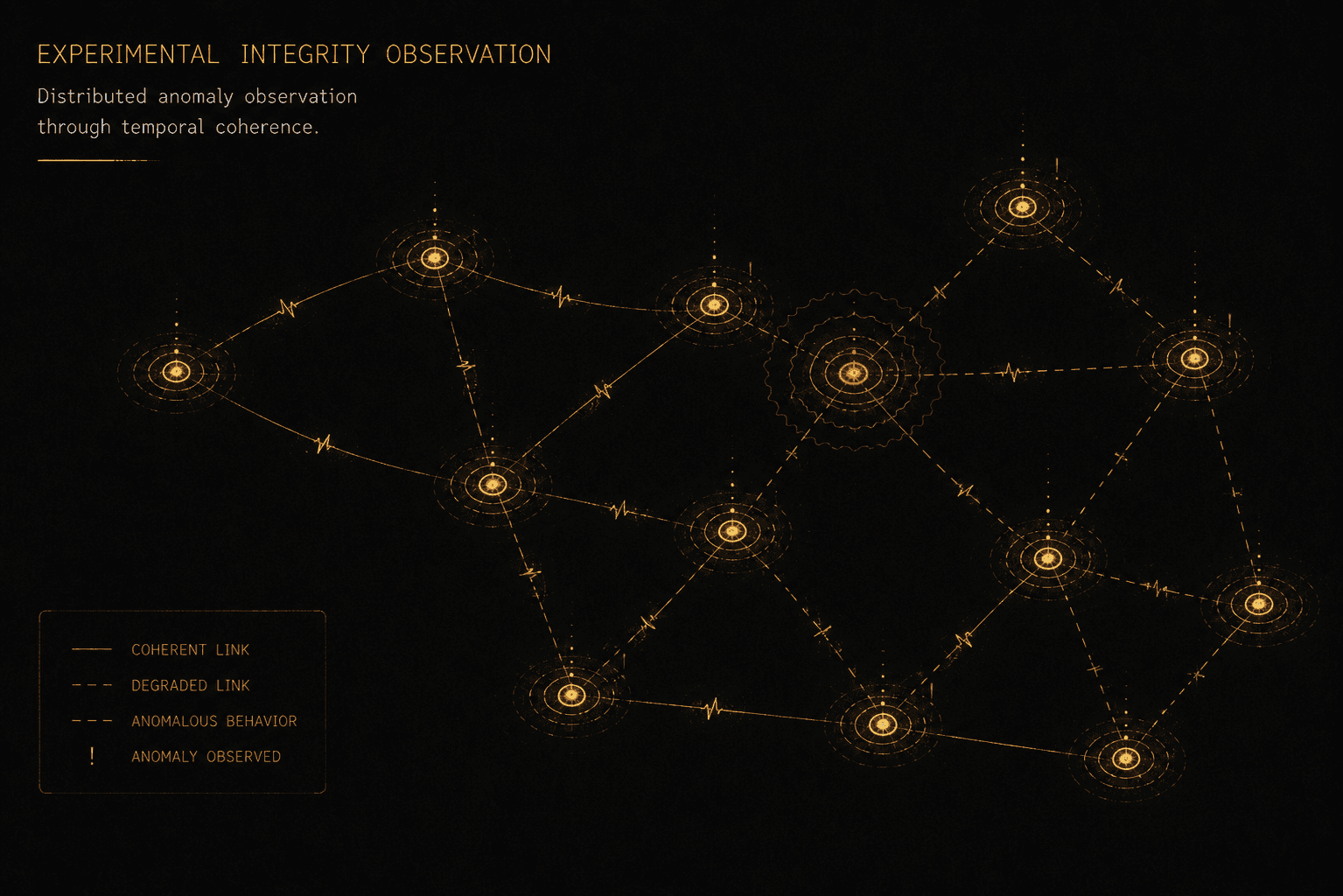

Jitter Observations

Average observed jitter remained around:

~1850 nanoseconds

This result must be interpreted carefully.

The measurement itself was performed using software timestamping on non-deterministic wireless hardware. Part of the observed jitter therefore originates from the measurement environment itself rather than the synchronization mechanisms alone.

ESP32 oscillators, wireless radio variability and software-level timing measurement all contribute noise to the system.

Under these conditions, maintaining stable synchronization behavior without drift amplification was one of the most significant observations.


Jitter Observations

Average observed jitter remained around:

~1850 nanoseconds

This result must be interpreted carefully.

The measurement itself was performed using software timestamping on non-deterministic wireless hardware. Part of the observed jitter therefore originates from the measurement environment itself rather than the synchronization mechanisms alone.

ESP32 oscillators, wireless radio variability and software-level timing measurement all contribute noise to the system.

Under these conditions, maintaining stable synchronization behavior without drift amplification was one of the most significant observations.

Experimental Observation Metrics

Experimental observations were conducted across a 5-node distributed embedded synchronization topology operating continuously for approximately 2 hours and 45 minutes over ESP-NOW wireless communication links without GNSS, PTP or centralized synchronization infrastructure.

The experimental topology included multi-hop synchronization propagation across constrained embedded relay nodes using software timestamping and non-deterministic wireless communication conditions.

Synchronization measurements were collected across the distributed relay nodes during the observation window, with 101 timing samples analyzed per observed node.

Across the tested relay nodes, synchronization jitter remained within relatively stable experimental ranges despite:

  • constrained embedded hardware

  • wireless propagation variability

  • software timestamping limitations

  • infrastructure-independent operation

Observed standard jitter values remained close across the tested nodes:

- Node 2: ~1850 ns

- Node 3: ~1834 ns

- Node 4: ~1842 ns

No significant drift amplification behavior was observed across the distributed relay topology during the tested synchronization propagation conditions.

Part of the observed jitter originates from the measurement environment itself, including:

- wireless propagation variability

- software timestamping limitations

- oscillator stability variation

- embedded processing latency

The purpose of these experiments was not to optimize absolute timing precision through specialized laboratory hardware, but to validate distributed synchronization continuity behavior under intentionally constrained operational conditions.


Experimental observations were conducted across a 5-node distributed embedded synchronization topology operating continuously for approximately 2 hours and 45 minutes over ESP-NOW wireless communication links without GNSS, PTP or centralized synchronization infrastructure.

The experimental topology included multi-hop synchronization propagation across constrained embedded relay nodes using software timestamping and non-deterministic wireless communication conditions.

Synchronization measurements were collected across the distributed relay nodes during the observation window, with 101 timing samples analyzed per observed node.

Across the tested relay nodes, synchronization jitter remained within relatively stable experimental ranges despite:

  • constrained embedded hardware

  • wireless propagation variability

  • software timestamping limitations

  • infrastructure-independent operation

Observed standard jitter values remained close across the tested nodes:

- Node 2: ~1850 ns

- Node 3: ~1834 ns

- Node 4: ~1842 ns

No significant drift amplification behavior was observed across the distributed relay topology during the tested synchronization propagation conditions.

Part of the observed jitter originates from the measurement environment itself, including:

- wireless propagation variability

- software timestamping limitations

- oscillator stability variation

- embedded processing latency

The purpose of these experiments was not to optimize absolute timing precision through specialized laboratory hardware, but to validate distributed synchronization continuity behavior under intentionally constrained operational conditions.

Synchronization stayed stable across distributed hops in real operating conditions

Why These Results Matter

The purpose of these experiments was not to create a theoretical laboratory demonstration disconnected from operational reality.

The systems were intentionally tested under constrained environments:
unstable hardware, degraded communication conditions, embedded limitations and infrastructure-independent operation.

The results suggest that distributed synchronization architectures may remain operationally stable even when traditional infrastructure assumptions disappear.

This has direct implications for environments where operational continuity and coordination remain critical despite degraded conditions.

Potential application environments include:

  • telecom resilience architectures

  • distributed embedded systems

  • tactical communication infrastructures

  • autonomous distributed platforms

  • edge computing synchronization

  • distributed sensing systems

  • infrastructure continuity architectures

As distributed infrastructures become increasingly autonomous and time-sensitive, maintaining stable coordination under degraded conditions becomes increasingly important.


The purpose of these experiments was not to create a theoretical laboratory demonstration disconnected from operational reality.

The systems were intentionally tested under constrained environments:
unstable hardware, degraded communication conditions, embedded limitations and infrastructure-independent operation.

The results suggest that distributed synchronization architectures may remain operationally stable even when traditional infrastructure assumptions disappear.

This has direct implications for environments where operational continuity and coordination remain critical despite degraded conditions.

Potential application environments include:

  • telecom resilience architectures

  • distributed embedded systems

  • tactical communication infrastructures

  • autonomous distributed platforms

  • edge computing synchronization

  • distributed sensing systems

  • infrastructure continuity architectures

As distributed infrastructures become increasingly autonomous and time-sensitive, maintaining stable coordination under degraded conditions becomes increasingly important.

Current Status

Experimental validation is currently ongoing across real embedded distributed environments operating under constrained conditions.

Initial intellectual property filings related to distributed synchronization, temporal coherence and resilient infrastructure architectures were initiated in 2026.

INNOV is currently open to technical discussions, collaborative validation opportunities and operational exchanges with industrial and research partners working on distributed systems, synchronization infrastructure and resilient operational architectures.


Experimental validation is currently ongoing across real embedded distributed environments operating under constrained conditions.

Initial intellectual property filings related to distributed synchronization, temporal coherence and resilient infrastructure architectures were initiated in 2026.

INNOV is currently open to technical discussions, collaborative validation opportunities and operational exchanges with industrial and research partners working on distributed systems, synchronization infrastructure and resilient operational architectures.

Open to exchange?

We are happy to discuss our technology and fields of use with you. Schedule a call directly or get in touch with us.

Open to exchange?

We are happy to discuss our technology and fields of use with you. Schedule a call directly or get in touch with us.

Copyright © 2026 INNOV Société. All rights reserved.

Copyright © 2026 INNOV Société.

All rights reserved.