GNSS Synchronization Vulnerabilities
Why permanent dependence on satellite timing signals introduces systemic fragility in modern distributed infrastructure.
Timing Has Quietly Become Critical Infrastructure
Global Navigation Satellite Systems — GPS (United States), Galileo (European Union), GLONASS (Russia) and BeiDou (China) — were initially designed for positioning and navigation. Over time, however, one of their most important functions became largely invisible to the public: precise time distribution.
These systems now form part of the broader global PNT (Positioning, Navigation and Timing) infrastructure relied upon by modern distributed systems.
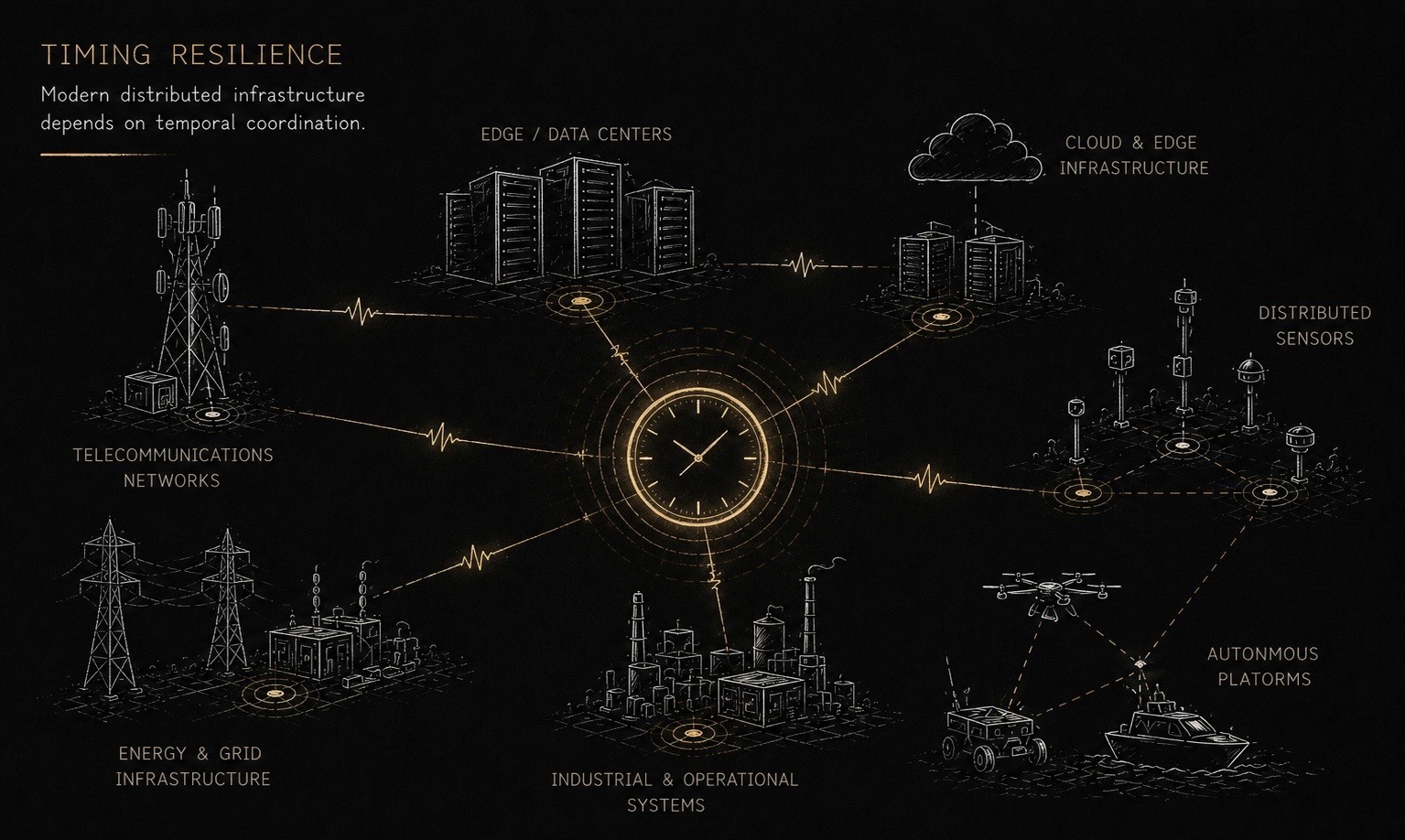
Today, modern distributed infrastructure depends heavily on GNSS-derived timing.
Telecommunications networks synchronize 4G and 5G base stations through satellite timing references. Financial infrastructures rely on precise timestamping for transaction sequencing and regulatory traceability. Power grids coordinate distributed substations using synchronized event timing. Cloud platforms and edge computing architectures depend on temporal consistency between geographically distributed systems. Tactical communication infrastructures use synchronized timing for deterministic communication protocols and coordination layers.
In most cases, the dependency pattern is remarkably similar:
GNSS becomes the authoritative external timing reference for systems that require distributed temporal coordination.
Under normal conditions, this architecture functions efficiently. GNSS provides globally accessible timing with extremely high precision and broad infrastructure compatibility. As a result, satellite timing progressively became embedded into the operational foundation of critical distributed systems across telecommunications, energy, finance, transportation, aerospace, defense and industrial infrastructure.
The issue is not that GNSS performs poorly.
The issue is that modern infrastructure increasingly assumes permanent timing availability from an external dependency that cannot always be guaranteed.
As distributed systems become more autonomous, latency-sensitive and infrastructure-dependent, synchronization resilience becomes a structural engineering concern rather than a secondary optimization layer.
Why Timing Resilience Matters
Modern infrastructure no longer operates as isolated systems.
Telecommunications networks, distributed cloud infrastructures, autonomous platforms, industrial automation systems, distributed sensing environments and critical operational architectures increasingly rely on continuous coordination between large populations of interconnected nodes.
In these environments, timing is not simply a technical parameter.
It becomes part of the operational foundation of the infrastructure itself.
Synchronization affects:
radio coordination in telecom networks
5G fronthaul synchronization
telecom grandmaster timing
IEEE 1588 telecom profiles
distributed transaction sequencing
edge computing coordination
timestamp integrity
deterministic communication protocols
sensor fusion architectures
distributed database consistency
failover coordination mechanisms
infrastructure continuity behavior
As infrastructures become increasingly software-defined and geographically distributed, maintaining synchronization continuity under degraded conditions becomes progressively more important.
A loss of timing coherence does not necessarily remain isolated to a single node or subsystem. It can propagate through dependent coordination layers, communication protocols and operational continuity mechanisms across the broader distributed architecture.
This is why resilient timing infrastructure and distributed synchronization resilience are becoming increasingly important topics across telecommunications, defense, critical infrastructure and distributed computing sectors.
Modern infrastructure no longer operates as isolated systems.
Telecommunications networks, distributed cloud infrastructures, autonomous platforms, industrial automation systems, distributed sensing environments and critical operational architectures increasingly rely on continuous coordination between large populations of interconnected nodes.
In these environments, timing is not simply a technical parameter.
It becomes part of the operational foundation of the infrastructure itself.
Synchronization affects:
radio coordination in telecom networks
distributed transaction sequencing
edge computing coordination
timestamp integrity
deterministic communication protocols
sensor fusion architectures
distributed database consistency
failover coordination mechanisms
infrastructure continuity behavior
As infrastructures become increasingly software-defined and geographically distributed, maintaining synchronization continuity under degraded conditions becomes progressively more important.
A loss of timing coherence does not necessarily remain isolated to a single node or subsystem. It can propagate through dependent coordination layers, communication protocols and operational continuity mechanisms across the broader distributed architecture.
This is why resilient timing infrastructure and distributed synchronization resilience are becoming increasingly important topics across telecommunications, defense, critical infrastructure and distributed computing sectors.
The Structural Vulnerability of GNSS Dependency
Modern distributed infrastructures increasingly face operational requirements associated with GPS-denied environments and degraded timing availability conditions.
The fundamental problem is not that GNSS is unreliable during stable operational conditions.
The problem is that stable operational conditions cannot be assumed indefinitely in critical infrastructure environments.
GNSS dependency concentrates synchronization continuity into a single external signal source that distributed systems do not control internally.
When that signal becomes degraded, unavailable or untrustworthy, systems designed around permanent GNSS availability may experience an immediate loss of temporal coordination.
This creates a structural fragility inside modern distributed infrastructure architectures.
The vulnerability is amplified by several characteristics inherent to satellite timing systems:
external dependency
extremely low received signal power
exposure to electromagnetic interference
limited authentication guarantees
line-of-sight requirements
centralized timing assumptions
These limitations are not theoretical.
They are documented operational realities affecting telecommunications infrastructure, military systems, transportation networks and distributed operational environments worldwide.
Documented Failure Modes
1. GNSS Jamming
GNSS signals arrive at ground level with extremely low power.
This makes them inherently vulnerable to radio frequency interference.
Relatively inexpensive jamming devices can suppress satellite reception across localized areas, while larger electronic warfare systems can deny GNSS reception across significantly wider operational regions.
For distributed systems relying on GNSS-derived timing, jamming does not simply degrade synchronization quality.
It removes the primary timing reference entirely.
In telecommunications infrastructure, this can affect base station coordination. In distributed sensing systems, timestamp consistency may become unreliable. In tactical communication architectures, synchronized access protocols may degrade rapidly.
The more infrastructure depends on a single external timing source, the more severe the operational consequences become during signal denial conditions.
GNSS
centralized synchronization servers
PTP grandmasters
NTP infrastructure
centralized IP timing architecture
The full synchronization behavior was maintained independently of external timing infrastructure during all validation phases.
2. GNSS Spoofing
Spoofing introduces a different category of risk.
Instead of suppressing the signal, spoofing generates counterfeit satellite timing information designed to appear legitimate to the receiver.
The receiver continues operating normally while processing compromised timing data.
This makes spoofing particularly dangerous for distributed systems because synchronization errors may propagate silently through the infrastructure without immediately triggering failure detection mechanisms.
Incorrect timing affects:
transaction sequencing
distributed coordination
event timestamping
synchronization continuity
deterministic communication layers
distributed operational logic
As software-defined radio platforms become more accessible, the technical barrier for executing sophisticated timing attacks continues to decrease.
Spoofing incidents have already been documented in maritime navigation, aerospace environments and contested operational regions.
3. Physical Signal Unavailability
GNSS requires sufficient satellite visibility.
Many operational environments naturally disrupt or prevent reliable satellite reception:
underground infrastructure
tunnels and subterranean facilities
dense urban environments
industrial environments
maritime conditions
mountainous terrain
dense foliage
shielded operational facilities
contested electromagnetic environments
In these conditions, distributed systems relying exclusively on GNSS lose their authoritative timing reference entirely.
This becomes particularly problematic for resilient distributed systems expected to maintain operational continuity under degraded infrastructure conditions.
4. Contested Electromagnetic Environments
Defense and critical infrastructure sectors increasingly recognize synchronization resilience as an operational requirement.
Modern electronic warfare capabilities routinely target positioning and timing infrastructure because degrading synchronization directly impacts distributed operational coordination.
Recent conflicts demonstrated widespread GNSS degradation affecting both military and civilian systems across operational regions.
In these environments, the challenge is no longer hypothetical.
Distributed systems must increasingly operate in conditions where external timing references may become unavailable, degraded or intentionally manipulated.
This shift is transforming resilient synchronization architecture into a strategic infrastructure concern.
5. Infrastructure Cascade Effects
Modern infrastructure sectors are deeply interconnected.
A synchronization failure inside telecommunications infrastructure can propagate into dependent operational systems:
financial transaction infrastructure
distributed cloud services
digital broadcasting systems
industrial automation environments
transportation coordination systems
energy infrastructure monitoring
Timing dependency therefore creates the possibility of cascade effects across interconnected distributed infrastructures.
The issue is not merely local synchronization degradation.
It is the systemic dependency created when multiple infrastructure sectors rely on the same external timing assumptions simultaneously.
Current Mitigation Approaches
Several mitigation strategies already exist.
Each improves resilience to some degree, but structural limitations remain.
1. GNSS Jamming
GNSS signals arrive at ground level with extremely low power.
This makes them inherently vulnerable to radio frequency interference.
Relatively inexpensive jamming devices can suppress satellite reception across localized areas, while larger electronic warfare systems can deny GNSS reception across significantly wider operational regions.
For distributed systems relying on GNSS-derived timing, jamming does not simply degrade synchronization quality.
It removes the primary timing reference entirely.
In telecommunications infrastructure, this can affect base station coordination. In distributed sensing systems, timestamp consistency may become unreliable. In tactical communication architectures, synchronized access protocols may degrade rapidly.
The more infrastructure depends on a single external timing source, the more severe the operational consequences become during signal denial conditions.
GNSS
centralized synchronization servers
PTP grandmasters
NTP infrastructure
centralized IP timing architecture
The full synchronization behavior was maintained independently of external timing infrastructure during all validation phases.
2. GNSS Spoofing
Spoofing introduces a different category of risk.
Instead of suppressing the signal, spoofing generates counterfeit satellite timing information designed to appear legitimate to the receiver.
The receiver continues operating normally while processing compromised timing data.
This makes spoofing particularly dangerous for distributed systems because synchronization errors may propagate silently through the infrastructure without immediately triggering failure detection mechanisms.
Incorrect timing affects:
transaction sequencing
distributed coordination
event timestamping
synchronization continuity
deterministic communication layers
distributed operational logic
As software-defined radio platforms become more accessible, the technical barrier for executing sophisticated timing attacks continues to decrease.
Spoofing incidents have already been documented in maritime navigation, aerospace environments and contested operational regions.
3. Physical Signal Unavailability
GNSS requires sufficient satellite visibility.
Many operational environments naturally disrupt or prevent reliable satellite reception:
underground infrastructure
tunnels and subterranean facilities
dense urban environments
industrial environments
maritime conditions
mountainous terrain
dense foliage
shielded operational facilities
contested electromagnetic environments
In these conditions, distributed systems relying exclusively on GNSS lose their authoritative timing reference entirely.
This becomes particularly problematic for resilient distributed systems expected to maintain operational continuity under degraded infrastructure conditions.
4. Contested Electromagnetic Environments
Defense and critical infrastructure sectors increasingly recognize synchronization resilience as an operational requirement.
Modern electronic warfare capabilities routinely target positioning and timing infrastructure because degrading synchronization directly impacts distributed operational coordination.
Recent conflicts demonstrated widespread GNSS degradation affecting both military and civilian systems across operational regions.
In these environments, the challenge is no longer hypothetical.
Distributed systems must increasingly operate in conditions where external timing references may become unavailable, degraded or intentionally manipulated.
This shift is transforming resilient synchronization architecture into a strategic infrastructure concern.
5. Infrastructure Cascade Effects
Modern infrastructure sectors are deeply interconnected.
A synchronization failure inside telecommunications infrastructure can propagate into dependent operational systems:
financial transaction infrastructure
distributed cloud services
digital broadcasting systems
industrial automation environments
transportation coordination systems
energy infrastructure monitoring
Timing dependency therefore creates the possibility of cascade effects across interconnected distributed infrastructures.
The issue is not merely local synchronization degradation.
It is the systemic dependency created when multiple infrastructure sectors rely on the same external timing assumptions simultaneously.
Current Mitigation Approaches
Several mitigation strategies already exist.
Each improves resilience to some degree, but structural limitations remain.
Holdover Oscillators
High-quality oscillators such as OCXOs or Rubidium standards can maintain synchronization temporarily after GNSS loss.
However, oscillator drift accumulates over time.
Depending on operational requirements and oscillator quality, holdover performance may remain viable for limited periods ranging from minutes to hours.
OCXO holdover and rubidium timing references improve short-term synchronization continuity but remain fundamentally dependent on eventual external timing recovery.
This extends operational continuity but does not eliminate dependency on external synchronization recovery.
Multi-Constellation GNSS
Using multiple satellite constellations improves resilience against single-network failure scenarios.
However, broadband jamming, electromagnetic degradation or coordinated interference still affect all satellite-based timing systems simultaneously.
The dependency remains external.
High-quality oscillators such as OCXOs or Rubidium standards can maintain synchronization temporarily after GNSS loss.
However, oscillator drift accumulates over time.
Depending on operational requirements and oscillator quality, holdover performance may remain viable for limited periods ranging from minutes to hours.
OCXO holdover and rubidium timing references improve short-term synchronization continuity but remain fundamentally dependent on eventual external timing recovery.
This extends operational continuity but does not eliminate dependency on external synchronization recovery.
Multi-Constellation GNSS
Using multiple satellite constellations improves resilience against single-network failure scenarios.
However, broadband jamming, electromagnetic degradation or coordinated interference still affect all satellite-based timing systems simultaneously.
The dependency remains external.
PTP and NTP Hierarchies
Precision Time Protocol (IEEE 1588) and Network Time Protocol distribute timing through network infrastructure.
These systems reduce direct GNSS exposure at edge nodes but typically maintain GNSS dependency at the infrastructure root through grandmaster timing systems.
The architectural dependency therefore remains concentrated at higher infrastructure layers.
Alternative Navigation and Timing Systems
Inertial systems and alternative timing architectures can improve operational resilience in certain environments.
However, cost, complexity, infrastructure requirements and long-term drift limitations restrict large-scale deployment across distributed embedded systems and telecommunications infrastructure.
The Architectural Gap
The challenge increasingly recognized across telecommunications, defense and critical infrastructure sectors is clear:
Critical distributed systems require synchronization continuity mechanisms capable of operating without permanent dependency on external timing references or centralized infrastructure assumptions.
More specifically, resilient distributed systems increasingly require:
distributed temporal coordination
synchronization continuity under degraded conditions
infrastructure-independent timing resilience
graceful degradation behavior
resilient network coordination
distributed synchronization continuity
operational coherence across autonomous node populations
This architectural gap is becoming increasingly relevant for:
5G and future telecom infrastructures
edge computing architectures
autonomous distributed platforms
industrial distributed systems
tactical communication infrastructures
resilient cloud infrastructure
distributed sensing systems
critical infrastructure continuity architectures
Across the industry, synchronization resilience is progressively evolving from a background technical assumption into an active infrastructure engineering challenge.
The Industry Shift
Telecommunications operators, infrastructure architects, defense organizations and distributed systems engineers increasingly recognize that permanent GNSS availability cannot always be assumed.
This recognition is influencing:
resilient telecom infrastructure planning
distributed synchronization research
critical infrastructure resilience requirements
timing assurance discussions
timing assurance framework
edge synchronization architectures
resilient operational continuity frameworks
distributed infrastructure coordination strategies
The shift is gradual but significant.
Distributed synchronization resilience is becoming part of broader discussions surrounding infrastructure independence, operational continuity and resilient distributed coordination.
PTP and NTP Hierarchies
Precision Time Protocol (IEEE 1588) and Network Time Protocol distribute timing through network infrastructure.
These systems reduce direct GNSS exposure at edge nodes but typically maintain GNSS dependency at the infrastructure root through grandmaster timing systems.
The architectural dependency therefore remains concentrated at higher infrastructure layers.
Alternative Navigation and Timing Systems
Inertial systems and alternative timing architectures can improve operational resilience in certain environments.
However, cost, complexity, infrastructure requirements and long-term drift limitations restrict large-scale deployment across distributed embedded systems and telecommunications infrastructure.
The Architectural Gap
The challenge increasingly recognized across telecommunications, defense and critical infrastructure sectors is clear:
Critical distributed systems require synchronization continuity mechanisms capable of operating without permanent dependency on external timing references or centralized infrastructure assumptions.
More specifically, resilient distributed systems increasingly require:
distributed temporal coordination
synchronization continuity under degraded conditions
infrastructure-independent timing resilience
graceful degradation behavior
resilient network coordination
distributed synchronization continuity
operational coherence across autonomous node populations
This architectural gap is becoming increasingly relevant for:
5G and future telecom infrastructures
edge computing architectures
autonomous distributed platforms
industrial distributed systems
tactical communication infrastructures
resilient cloud infrastructure
distributed sensing systems
critical infrastructure continuity architectures
Across the industry, synchronization resilience is progressively evolving from a background technical assumption into an active infrastructure engineering challenge.
The Industry Shift
Telecommunications operators, infrastructure architects, defense organizations and distributed systems engineers increasingly recognize that permanent GNSS availability cannot always be assumed.
This recognition is influencing:
resilient telecom infrastructure planning
distributed synchronization research
critical infrastructure resilience requirements
timing assurance discussions
edge synchronization architectures
resilient operational continuity frameworks
distributed infrastructure coordination strategies
The shift is gradual but significant.
Distributed synchronization resilience is becoming part of broader discussions surrounding infrastructure independence, operational continuity and resilient distributed coordination.
INNOV’s Approach
INNOV Sync explores distributed synchronization architectures designed to maintain temporal coherence without permanent dependency on GNSS or centralized infrastructure.
The objective is not to replace existing synchronization systems.
GNSS, PTP and NTP remain highly effective under many operational scenarios.
The objective is instead to explore complementary resilience architectures capable of maintaining synchronization continuity when traditional infrastructure assumptions become unreliable.
Experimental validation environments intentionally operated under constrained conditions:
non-deterministic wireless communication
software-level timestamping
unstable embedded oscillators
distributed multi-hop propagation
infrastructure-independent operation
degraded communication conditions
Under these operational constraints, synchronization behavior stayed coherent across distributed hops without observable drift amplification.
Alongside synchronization continuity validation, experimental integrity observation mechanisms were also evaluated under the same distributed operating conditions.
The underlying distributed synchronization and temporal coherence architectures are currently protected through intellectual property filings initiated in 2026.
INNOV Sync explores distributed synchronization architectures designed to maintain temporal coherence without permanent dependency on GNSS or centralized infrastructure.
The objective is not to replace existing synchronization systems.
GNSS, PTP and NTP remain highly effective under many operational scenarios.
The objective is instead to explore complementary resilience architectures capable of maintaining synchronization continuity when traditional infrastructure assumptions become unreliable.
Experimental validation environments intentionally operated under constrained conditions:
non-deterministic wireless communication
software-level timestamping
unstable embedded oscillators
distributed multi-hop propagation
infrastructure-independent operation
degraded communication conditions
Under these operational constraints, synchronization behavior stayed coherent across distributed hops without observable drift amplification.
Alongside synchronization continuity validation, experimental integrity observation mechanisms were also evaluated under the same distributed operating conditions.
The underlying distributed synchronization and temporal coherence architectures are currently protected through intellectual property filings initiated in 2026.
Summary
Modern distributed infrastructure increasingly depends on GNSS-derived timing for synchronization continuity and operational coordination
GNSS signals remain vulnerable to jamming, spoofing, electromagnetic degradation and physical signal unavailability
Existing mitigation approaches improve resilience but do not fully eliminate dependency on external timing infrastructure
Distributed systems increasingly require resilient synchronization architectures capable of maintaining temporal coherence under degraded operational conditions
Synchronization resilience is becoming a strategic infrastructure concern across telecommunications, defense, edge computing and critical infrastructure sectors
Distributed synchronization continuity and infrastructure-independent coordination represent an increasingly important engineering challenge for future resilient distributed systems.
Timing resilience and distributed synchronization continuity are becoming critical engineering priorities for next-generation distributed infrastructure systems.
Relevant synchronization standards, telecom timing architectures and operational resilience environments associated with GNSS dependency and distributed timing continuity include:
IEEE 1588 Precision Time Protocol (PTP)
ITU-T G.8273 / G.8275 telecom PTP profiles
Telecom Grand Master (T-GM)
Telecom Boundary Clock (T-BC)
Telecom Time Slave Clock (T-TSC)
RFC 5905 Network Time Protocol (NTP)
3GPP 5G fronthaul timing requirements
ETSI EN 303 340 mobile network synchronization
IEEE C37.118 synchrophasor infrastructures
PNT (Positioning, Navigation and Timing) architectures
GNSS-contested and GPS-denied operational environments
NIS2 critical infrastructure resilience requirements
Holdover performance under GNSS signal loss
Modern distributed infrastructure increasingly depends on GNSS-derived timing for synchronization continuity and operational coordination
GNSS signals remain vulnerable to jamming, spoofing, electromagnetic degradation and physical signal unavailability
Existing mitigation approaches improve resilience but do not fully eliminate dependency on external timing infrastructure
Distributed systems increasingly require resilient synchronization architectures capable of maintaining temporal coherence under degraded operational conditions
Synchronization resilience is becoming a strategic infrastructure concern across telecommunications, defense, edge computing and critical infrastructure sectors
Distributed synchronization continuity and infrastructure-independent coordination represent an increasingly important engineering challenge for future resilient distributed systems.
Timing resilience and distributed synchronization continuity are becoming critical engineering priorities for next-generation distributed infrastructure systems.
Relevant synchronization standards, telecom timing architectures and operational resilience environments associated with GNSS dependency and distributed timing continuity include:
IEEE 1588 Precision Time Protocol (PTP)
ITU-T G.8273 / G.8275 telecom PTP profiles
Telecom Grand Master (T-GM)
Telecom Boundary Clock (T-BC)
Telecom Time Slave Clock (T-TSC)
RFC 5905 Network Time Protocol (NTP)
3GPP 5G fronthaul timing requirements
ETSI EN 303 340 mobile network synchronization
IEEE C37.118 synchrophasor infrastructures
PNT (Positioning, Navigation and Timing) architectures
GNSS-contested and GPS-denied operational environments
NIS2 critical infrastructure resilience requirements
Holdover performance under GNSS signal loss
Current Status
Initial experimental campaigns conducted over 110+ hours of continuous operation on constrained embedded hardware have demonstrated stable distributed temporal coherence without external reference, with results significantly outperforming conventional protocols under identical conditions.
Initial intellectual property filings related to distributed synchronization, temporal coherence and resilient infrastructure architectures were initiated in 2026.
INNOV is currently open to technical discussions, collaborative validation opportunities and operational exchanges with industrial and research partners working on distributed systems, synchronization infrastructure and resilient operational architectures.
Initial experimental campaigns conducted over 110+ hours of continuous operation on constrained embedded hardware have demonstrated stable distributed temporal coherence without external reference, with results significantly outperforming conventional protocols under identical conditions.
Initial intellectual property filings related to distributed synchronization, temporal coherence and resilient infrastructure architectures were initiated in 2026.
INNOV is currently open to technical discussions, collaborative validation opportunities and operational exchanges with industrial and research partners working on distributed systems, synchronization infrastructure and resilient operational architectures.
Open to exchange?
Open to exchange?

Copyright © 2026 INNOV Société. All rights reserved.
Copyright © 2026 INNOV Société.
All rights reserved.