Energy & Smart Grids

Modern electrical grids are evolving into highly distributed infrastructures. Transmission operators, substations, renewable generation, storage systems and distributed protection devices must continuously coordinate their actions across increasingly complex networks.

This coordination depends on a common temporal reference. Accurate timing supports event sequencing, fault analysis, protection coordination and the operation of distributed control systems. As electrical infrastructures become more decentralized, maintaining temporal coherence across the network becomes increasingly critical for operational resilience.

Rather than introducing a new protection system, IDSS explores a different architectural approach: maintaining distributed temporal coherence even when external timing conditions become degraded.

The synchronization mechanisms presented on this page have already been demonstrated on IDSS prototypes. The objective of the industrial programme is now to evaluate how these mechanisms translate into measurable operational and economic value on production-scale electrical infrastructures.

Prototype Results

The following mechanisms have already been demonstrated on early IDSS prototypes built on low-cost ESP32 microcontrollers operating under constrained hardware conditions.

These results do not represent industrial performance claims. They demonstrate that the fundamental synchronization mechanisms operate successfully, providing the basis for future industrial validation.

  • 98% reduction in synchronization traffic while maintaining temporal coherence.

  • Temporal coherence was maintained for more than 110 hours during continuous operation.

  • Creation of an autonomous distributed time reference, independent of continuous UTC synchronization.

  • Dynamic distributed election allowing the network to continuously adapt its synchronization hierarchy.

  • Temporal coherence maintained without continuous GNSS dependency.

These observations validate the core mechanisms of IDSS.

The next step is to evaluate how these mechanisms translate into measurable operational benefits on real telecommunications infrastructures.

These observations validate the core mechanisms of IDSS. The purpose of industrial validation is now to quantify their operational value.

The following mechanisms have already been demonstrated on early IDSS prototypes built on low-cost ESP32 microcontrollers operating under constrained hardware conditions.

These results do not represent industrial performance claims. They demonstrate that the fundamental synchronization mechanisms operate successfully, providing the basis for future industrial validation.

  • 98% reduction in synchronization traffic while maintaining temporal coherence.

  • Temporal coherence was maintained for more than 110 hours during continuous operation.

  • Creation of an autonomous distributed time reference, independent of continuous UTC synchronization.

  • Dynamic distributed election allowing the network to continuously adapt its synchronization hierarchy.

  • Temporal coherence maintained without continuous GNSS dependency.

These observations validate the core mechanisms of IDSS.

The next step is to evaluate how these mechanisms translate into measurable operational benefits on real telecommunications infrastructures.

These observations validate the core mechanisms of IDSS. The purpose of industrial validation is now to quantify their operational value.


What These Results Could Mean for Electrical Grids
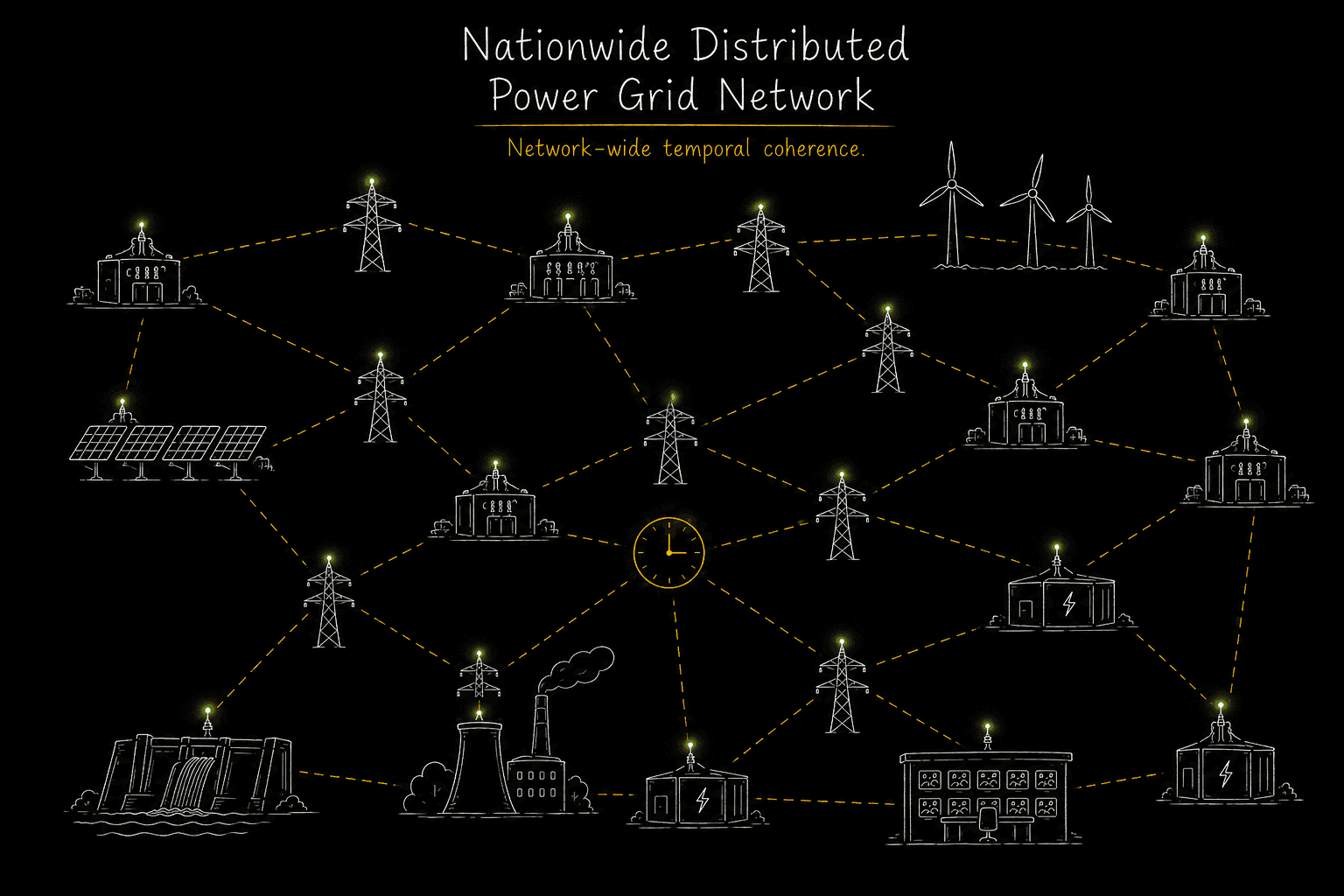

The following observations are not standalone projections. Every potential benefit presented below is directly derived from synchronization mechanisms already demonstrated on IDSS prototypes operating on constrained, low-cost hardware platforms that were never originally designed for distributed high-precision synchronization.

If these mechanisms can operate under such conditions, the next challenge is no longer to demonstrate that they work, but to quantify the operational, technical and economic value they can generate at production scale across real telecommunications infrastructures.

Reduced synchronization-related communication overhead

Observed on prototype

98% less synchronization traffic while maintaining distributed temporal coherence.

What this could mean for electrical grids?

The objective is not necessarily to reproduce the exact reduction observed on our prototypes. Even a partial reduction in synchronization traffic compared with today’s conventional approaches could represent meaningful operational, economic and resilience gains for future electrical infrastructures.

Autonomous distributed time reference

Observed on prototype

Distributed temporal reference maintained without continuous GNSS timing.

What this could mean for electrical grids?

Electrical infrastructures could maintain temporal coherence even during temporary GNSS outages or degraded external timing conditions, reducing dependence on continuous satellite-based timing availability.

Distributed synchronization without a permanent central reference

Observed on prototype

Temporal coherence maintained through dynamic distributed synchronization.

What this could mean for electrical grids?

Rather than relying exclusively on centralized timing distribution, distributed assets could continue sharing a coherent temporal reference collectively, reducing architectural single points of failure across large electrical infrastructures.

See how this perspective applies in our Real-World Case Study on the 2025 Iberian blackout.

Stable temporal coherence during long-duration operation

Observed on prototype

Stable temporal coherence maintained for more than 110 continuous hours.

What this could mean for electrical grids?

Long-term synchronization stability could reduce operational supervision while improving the consistency of distributed protection, monitoring and grid control systems.

Higher inter-node temporal coherence

Observed on prototype

40 - 60x  higher inter-node temporal coherence than NTP and the evaluated software-based PTP implementation on identical ESP32 hardware.

What this could mean for electrical grids?

If confirmed through industrial validation, this level of synchronization quality could enable more deterministic coordination between substations, distributed protection devices and grid automation systems without requiring more capable edge hardware.

Faster understanding of grid disturbances

Observed on prototype

Consistent temporal coherence maintained across all participating nodes throughout continuous operation.

What this could mean for electrical grids?

Maintaining a common temporal reference across geographically distributed infrastructures could facilitate event reconstruction, disturbance analysis and root-cause investigation by preserving a coherent chronology of events throughout the grid.


The mechanisms presented above have already been demonstrated on IDSS prototypes. Industrial validation now focuses on quantifying the operational, technical and economic gains they may generate on real telecommunications infrastructures.

The following observations are not standalone projections. Every potential benefit presented below is directly derived from synchronization mechanisms already demonstrated on IDSS prototypes operating on constrained, low-cost hardware platforms that were never originally designed for distributed high-precision synchronization.

If these mechanisms can operate under such conditions, the next challenge is no longer to demonstrate that they work, but to quantify the operational, technical and economic value they can generate at production scale across real telecommunications infrastructures.

Reduced synchronization-related communication overhead

Observed on prototype

98% less synchronization traffic while maintaining distributed temporal coherence.

What this could mean for electrical grids?

The objective is not necessarily to reproduce the exact reduction observed on our prototypes. Even a partial reduction in synchronization traffic compared with today’s conventional approaches could represent meaningful operational, economic and resilience gains for future electrical infrastructures.

Autonomous distributed time reference

Observed on prototype

Distributed temporal reference maintained without continuous GNSS timing.

What this could mean for electrical grids?

Electrical infrastructures could maintain temporal coherence even during temporary GNSS outages or degraded external timing conditions, reducing dependence on continuous satellite-based timing availability.

Distributed synchronization without a permanent central reference

Observed on prototype

Temporal coherence maintained through dynamic distributed synchronization.

What this could mean for electrical grids?

Rather than relying exclusively on centralized timing distribution, distributed assets could continue sharing a coherent temporal reference collectively, reducing architectural single points of failure across large electrical infrastructures.

See how this perspective applies in our Real-World Case Study on the 2025 Iberian blackout.

Stable temporal coherence during long-duration operation

Observed on prototype

Stable temporal coherence maintained for more than 110 continuous hours.

What this could mean for electrical grids?

Long-term synchronization stability could reduce operational supervision while improving the consistency of distributed protection, monitoring and grid control systems.

Higher inter-node temporal coherence

Observed on prototype

40 - 60x  higher inter-node temporal coherence than NTP and the evaluated software-based PTP implementation on identical ESP32 hardware.

What this could mean for electrical grids?

If confirmed through industrial validation, this level of synchronization quality could enable more deterministic coordination between substations, distributed protection devices and grid automation systems without requiring more capable edge hardware.

Faster understanding of grid disturbances

Observed on prototype

Consistent temporal coherence maintained across all participating nodes throughout continuous operation.

What this could mean for electrical grids?

Maintaining a common temporal reference across geographically distributed infrastructures could facilitate event reconstruction, disturbance analysis and root-cause investigation by preserving a coherent chronology of events throughout the grid.


The mechanisms presented above have already been demonstrated on IDSS prototypes. Industrial validation now focuses on quantifying the operational, technical and economic gains they may generate on real telecommunications infrastructures.

How Network Failures Could Evolve

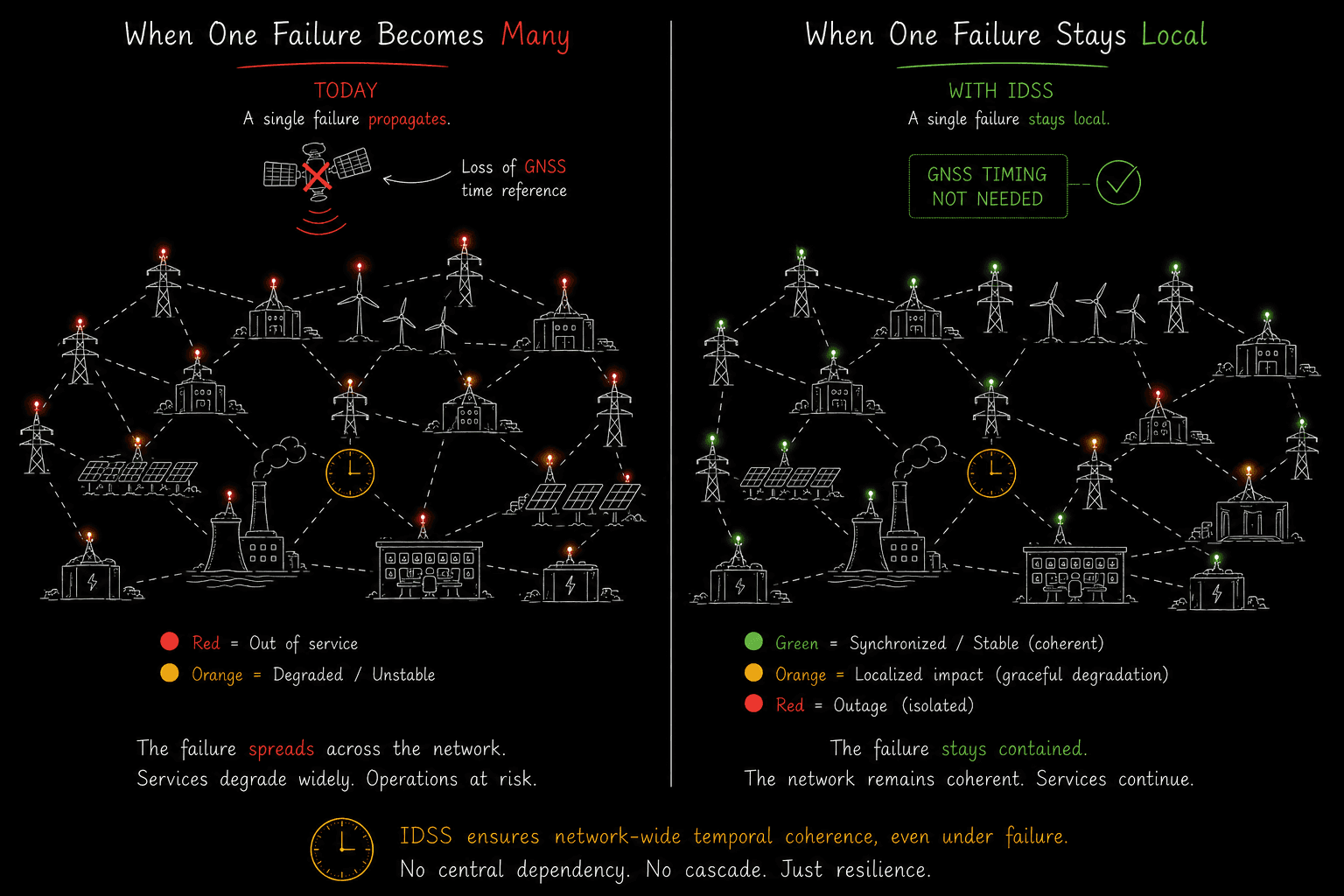
Modern power grids are designed to remain operational despite localized equipment failures. However, when a shared dependency such as a continuous GNSS timing reference becomes unavailable or degraded, the consequences may extend well beyond the initial point of disruption.

As temporal coherence progressively deteriorates across substations, protection systems and distributed energy assets, independent components may begin making decisions based on inconsistent timing information. Local disturbances can then propagate through the electrical infrastructure, increasing operational complexity, complicating event analysis and extending recovery times.

See how this perspective applies in our Real-World Case Study on the 2025 Iberian blackout.

The synchronization mechanisms demonstrated on IDSS prototypes suggest a different behavior.

Rather than allowing temporal degradation to progressively affect the entire grid, distributed temporal coherence could enable electrical infrastructures to preserve a common time reference across unaffected assets while confining the impact to the area directly experiencing the disturbance.

The objective of industrial validation is now to quantify how these demonstrated mechanisms translate into operational resilience on production-scale power grid infrastructures.

The illustration below is not intended to describe an algorithm. It illustrates the observable behavior that the synchronization mechanisms demonstrated on IDSS prototypes could enable once validated at industrial scale.

Looking Beyond Industrial Validation

IDSS is designed to integrate with today’s synchronization infrastructures while remaining compatible with existing power system architectures and synchronization standards. It does not require grid operators to redesign their infrastructures, but to evaluate an alternative approach to maintaining temporal coherence when continuous GNSS timing becomes unavailable.

The synchronization mechanisms demonstrated on IDSS prototypes do not seek to bypass existing standards. Their purpose is to generate the operational evidence required to evaluate how future synchronization standards could evolve as power systems become increasingly distributed and as resilience against GNSS disruptions becomes a strategic requirement.

Every generation of infrastructure standards has emerged from measurable operational evidence. The objective of the IDSS industrial programme is to determine whether distributed temporal coherence can contribute to the next evolution of resilient synchronization for critical electrical infrastructures.

For transmission operators, distribution operators, utilities and equipment manufacturers, the question may soon no longer be whether distributed temporal coherence is technically achievable, but whether they want to contribute to defining its future or adopt it once the industry has already moved forward.

Standards rarely change because of ideas. They evolve because new evidence makes evolution necessary.


IDSS is designed to integrate with today’s synchronization infrastructures while remaining compatible with existing power system architectures and synchronization standards. It does not require grid operators to redesign their infrastructures, but to evaluate an alternative approach to maintaining temporal coherence when continuous GNSS timing becomes unavailable.

The synchronization mechanisms demonstrated on IDSS prototypes do not seek to bypass existing standards. Their purpose is to generate the operational evidence required to evaluate how future synchronization standards could evolve as power systems become increasingly distributed and as resilience against GNSS disruptions becomes a strategic requirement.

Every generation of infrastructure standards has emerged from measurable operational evidence. The objective of the IDSS industrial programme is to determine whether distributed temporal coherence can contribute to the next evolution of resilient synchronization for critical electrical infrastructures.

For transmission operators, distribution operators, utilities and equipment manufacturers, the question may soon no longer be whether distributed temporal coherence is technically achievable, but whether they want to contribute to defining its future or adopt it once the industry has already moved forward.

Standards rarely change because of ideas. They evolve because new evidence makes evolution necessary.


Open to exchange?

We are happy to discuss our technology and fields of use with you. Schedule a call directly or get in touch with us.

Open to exchange?

We are happy to discuss our technology and fields of use with you. Schedule a call directly or get in touch with us.